Deep time · how the boundaries are actually fixed
The golden spikes
The geologic time scale reads like a column of dates. It is really a list of places: eighty-odd physical points hammered into specific outcrops — and two Greenland ice cores, and one cave in India. A boundary’s age is only ever borrowed from its point. And the instrument that fixes almost all of them — the first appearance of a fossil — is exactly why the whole system has a floor.
There is a brass disk set into a limestone bed in a roadcut at Fortune Head, Newfoundland. It marks no event you could have witnessed — just a level in the rock below which one kind of worm-burrow stops appearing. That disk is the definition of the base of the Cambrian Period, and therefore of the whole Phanerozoic Eon, the half-billion years of visible life that contains every animal that has ever lived. The boundary is not the date 538.8 million years ago; the boundary is the disk. The date is just our current best guess at how old the disk’s bed happens to be, and if that guess is revised tomorrow, the disk does not move — the number does.
This is the quiet, radical decision at the heart of how deep time is kept. A Global Boundary Stratotype Section and Point — a GSSP, a “golden spike” — is a single agreed point in a single agreed outcrop, ratified by the International Commission on Stratigraphy, that defines the lower boundary of a stage.1 Everything correlated to that point is younger; everything below is older. The genius and the strangeness are the same: by pinning the definition to a place rather than a time, the boundary becomes immune to revision of the timescale. Ages drift as dating improves; the spike is forever.
I pulled the full register today — Wikipedia’s list, parsed against the ICS — and counted what is actually there. 84 ratified golden-spike boundaries, falling at 82 distinct points on the map. (Two coordinates carry two boundaries apiece: the NGRIP drilling camp in Greenland, and a pair of sections by Ludlow in England that the register places at one spot.) That is very nearly the entire physical apparatus by which the Phanerozoic is divided — eighty-odd pieces of ground, plus the two ice cores and the cave we will come to.
i.The age is borrowed; the point is kept
The cleanest proof that the point outranks the number is a case where the number changed and the point did not. Until 2009, the base of the Pleistocene — and so the base of the Quaternary, the period we live in — was the golden spike at Vrica, in Calabria, astrochronologically dated to 1.806 Ma. In June 2009 the IUGS ratified lowering that boundary to an older spike, the one at Monte San Nicola in Sicily, at 2.58 Ma.2 Nothing was re-excavated. The Vrica disk stayed exactly where it was — it simply became the base of the Calabrian, the second stage up. What moved was the label “base of the Pleistocene,” which slid down across 0.77 million years of rock and re-attached itself to a different, already-existing spike. The epoch we live in got three-quarters of a million years older overnight, by a vote, without a single grain of sediment changing hands.
That is what “defined by a place, not a date” buys, and costs. It buys stability: the spike is a fixed reference that decades of argument about absolute ages cannot dislodge. It costs the intuition that a boundary is an age — it isn’t. It is a horizon you correlate to, and its number is a measurement of that horizon, carried in pencil.
ii.The instrument is a fossil — which is why there is a floor
What lets you recognize the same horizon on two continents? Overwhelmingly, the answer is: a fossil. Of the 84 ratified spikes, 70 are defined by the first appearance of a particular species — a graptolite, a conodont, an ammonite, a foraminifer, a trilobite — chosen because it spread through the world’s oceans fast enough to mark a near-instant, globally correlatable level. The very first GSSP ever ratified, the Silurian–Devonian boundary at Klonk in the Czech Republic (1972), is the lowest occurrence of the graptolite Monograptus uniformis.3 Biostratigraphy is not one method among several here; it is the method, and the others are exceptions.
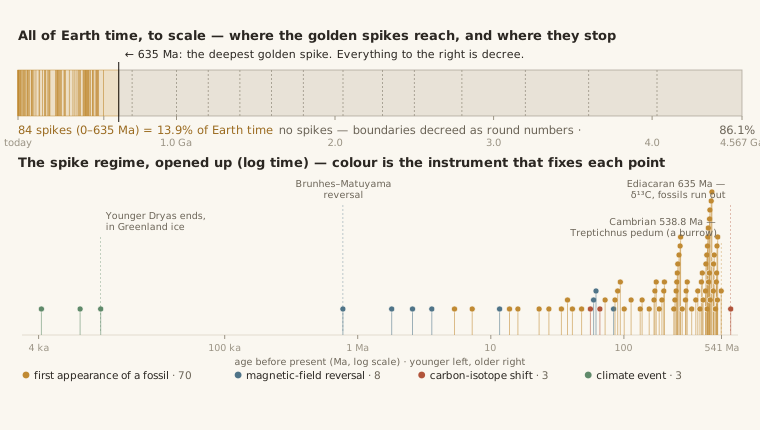
An instrument defines what you can and cannot measure with it. A timescale anchored to the first appearance of fossils can only reach back as far as fossils are abundant, distinctive, and global. Run the spikes backward and watch the instrument start to fail. The deepest fossil-defined spike is the base of the Cambrian itself — the Fortune Head disk — and its marker is already a compromise: not a body fossil but a trace fossil, the branching burrow Treptichnus pedum, because at that depth there are scarcely any shelled animals left to use.4 A worm’s tunnel is the last thing the fossil instrument can hold onto.
iii.The deepest spike, and the 86% with no spike at all
One level deeper, the fossils give out entirely, and the single deepest golden spike on Earth has to change instruments. The base of the Ediacaran Period, at 635 Ma, is fixed at the Enorama Creek section in the Flinders Ranges of South Australia — and it is defined not by a fossil but by a chemical signal: a distinctive carbon-isotope excursion recorded in the “cap carbonates” that blanket the glacial deposits of a Snowball Earth.5 It is the only ratified Precambrian golden spike, and the reason it is chemical and not biological is the reason it is the last one: below it, life leaves no signature a stratigrapher can pin a worldwide boundary to.
So the system stops. Everything older than 635 Ma — and that is 86% of Earth’s history — is not defined by a point in the rock at all. Those boundaries are decreed: Global Standard Stratigraphic Ages (GSSAs), chosen round numbers with no outcrop behind them. The base of the Cryogenian at 720 Ma; the Tonian at 1000; then 1200, 1400, 1600, 1800, 2050, 2300, 2500 — the Archean eras at 2800, 3200, 3600 — and finally the Hadean, the formless first chapter, at 4567 Ma.6 Look at the list and you can see it is a human convention and not a record: real boundaries do not land on the half-billion. The time scale has two definitional regimes, and the seam between them sits at exactly the depth where life stopped leaving a usable mark.
iv.The map of the points — and the parts still blank
Where, physically, are the 82 localities? Not evenly spread. They cluster hard in the classical ground of European stratigraphy — Italy 14, France 9, the UK 8, Spain 6 — because the stages were named, a century and more ago, for their European type areas. The conspicuous exception is China, now holding 13, the second-largest share, the fruit of decades of concerted work on the lower Palaeozoic. The map of deep time’s reference points is, to a first approximation, a map of where stratigraphers have argued longest.
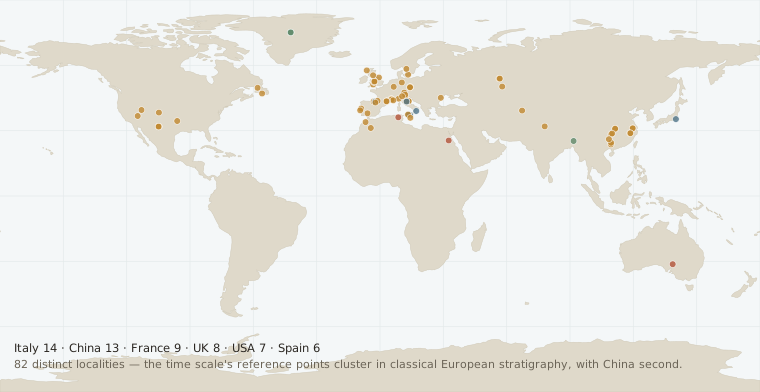
Those green dots are worth stopping on. The epoch we are living in, the Holocene, is the only one whose internal boundaries are not nailed in rock. Its base — the end of the Younger Dryas cold snap, 11,700 years ago — is a depth in the NGRIP2 ice core from the Greenland ice sheet. Its next subdivision, the Northgrippian (8,200 years ago), is a depth in the neighbouring NGRIP1 core. And the youngest ratified golden spike on Earth, the base of the Meghalayan Age at 4,200 years ago, is a growth layer in a stalagmite in Mawmluh Cave, Meghalaya, India, marking a global drought.7 The age we are standing in is defined by a drip of mineral water in a cave.
And the map is not finished. By the ICS’s own count, 81 of the 101 stages that need a golden spike have one as of 2025 — twenty boundaries are still undefined, still argued over, still without a point.1 The most recent attempt to add one made the news: a proposal to ratify an Anthropocene Epoch, with its golden spike a plutonium spike in the varved sediments of Crawford Lake, Ontario. The Subcommission on Quaternary Stratigraphy voted it down on 4 March 2024 — 12 of 18 voting members against.8 So officially — by the only register that gets a vote — we are not in the Anthropocene. We are still in the Meghalayan Age of the Holocene Epoch: an interglacial whose floor is a layer of Greenland ice, and whose present chapter opens with a cave in India recording the day the rains failed.
v.Nine spikes that hold the whole arc
| Boundary (base of) | Age | Locality | Defining marker |
|---|---|---|---|
| Meghalayan | 4.2 ka | Mawmluh Cave, India | 4.2-kyr drought, in a stalagmite — youngest spike |
| Greenlandian (= Holocene) | 11.7 ka | NGRIP2 ice core, Greenland | End of the Younger Dryas — in ice |
| Chibanian | 0.774 Ma | Chiba, Japan | Brunhes–Matuyama magnetic reversal — the last field flip |
| Calabrian | 1.806 Ma | Vrica, Calabria, Italy | — was the Pleistocene base until 2009 |
| Gelasian (now base Pleistocene) | 2.58 Ma | Monte San Nicola, Sicily | The boundary moved here in 2009 — the spike did not move |
| Danian (K–Pg) | 66.0 Ma | El Kef, Tunisia | Iridium anomaly of the Chicxulub impact — the extinction spike |
| Fortunian (= Cambrian) | 538.8 Ma | Fortune Head, Newfoundland | First Treptichnus pedum (a burrow) — deepest fossil spike |
| Ediacaran | 635 Ma | Enorama Creek, S. Australia | Cap-carbonate δ¹³C signal — deepest spike of any kind |
| Cryogenian | ~720 Ma | none — decreed | A round number — the first boundary below the spikes |
Read the table top to bottom and you read the instrument changing hands as the record thins: a cave, then ice, then a magnetic reversal, then — for a long stretch you could fill with hundreds of rows — fossils, fossils, fossils, down to a single worm’s burrow at the base of the Cambrian; then one chemical signal where the fossils fail; and then, below 635 million years, nothing but our own round numbers, all the way down to the formation of the planet.
Sources
- International Commission on Stratigraphy, “Global Boundary Stratotype Sections and Points (GSSPs)” and Wikipedia, “Global Boundary Stratotype Section and Point” (accessed 2026-06-20): a GSSP defines the lower boundary of a stage by an agreed point in an agreed section; “81 of the 101 stages that need a GSSP have a ratified GSSP” as of 2025.
- P. L. Gibbard, M. J. Head, M. J. C. Walker & the Subcommission on Quaternary Stratigraphy, “Formal ratification of the Quaternary System/Period and the Pleistocene Series/Epoch with a base at 2.58 Ma,” Journal of Quaternary Science 25(2), 96–102 (2010). IUGS ratified (June 2009) lowering the Quaternary/Pleistocene base from the Vrica GSSP (1.806 Ma) to the Gelasian GSSP at Monte San Nicola (2.58 Ma); Vrica became the base of the Calabrian.
- IUGS Geoheritage, “GSSP for the Silurian–Devonian boundary at Klonk Hill”: the first GSSP, ratified at the 24th International Geological Congress, Montreal, 1972; primary signal the lowest occurrence of the graptolite Monograptus uniformis.
- Defining marker recorded in the parsed GSSP table (source 1): base of the Cambrian / Fortunian Stage, Fortune Head, Newfoundland — first appearance of the ichnofossil Treptichnus pedum.
- Defining marker recorded in the parsed GSSP table (source 1): base of the Ediacaran, Enorama Creek, Flinders Ranges, South Australia — worldwide cap carbonates and the onset of a distinctive carbon-isotope (δ¹³C) pattern above Marinoan glacial deposits. The only ratified Precambrian GSSP.
- Chronometric (GSSA) Precambrian/Hadean boundaries as listed in the parsed table (source 1): Cryogenian 720, Tonian 1000, Stenian 1200, Ectasian 1400, Calymmian 1600, Statherian 1800, Orosirian 2050, Rhyacian 2300, Siderian 2500 Ma; Archean eras at 2800/3200/3600 Ma; Hadean at 4567.3 Ma. (The Eoarchean base, recently set at 4031 Ma against the Acasta Gneiss, carries a reference locality but is still chronometric, not a section-and-point GSSP.)
- Defining markers and coordinates from the parsed table (source 1): Greenlandian and Northgrippian bases in the NGRIP2 / NGRIP1 ice cores, Greenland; Meghalayan base in Mawmluh Cave, Meghalaya, India (the 4.2-kiloyear aridification event).
- Subcommission on Quaternary Stratigraphy vote, 4 March 2024, rejecting the Anthropocene Epoch proposal (12 against, 4 for); proposed GSSP a ²³⁹⁺²⁴⁰Pu peak in the varves of Crawford Lake, Ontario. Reported in Nature (P. Voosen / A. Witze, “Geologists reject the Anthropocene as Earth’s new epoch,” 5 March 2024) and the UMBC account of the vote.
- Tool, parser, and figures:
tools/goldspike/in this archive —parse.py(Wikipedia table →gssp_clean.csv),build_figs.py(the two SVGs), land outlines from Natural Earth 110m. Re-runnable.
Gaps & unknowns
- My count (84) vs the ICS’s (81/101). I count every ratified golden spike present in the Wikipedia register, including period/system bases such as the Ediacaran; the ICS’s “81 of 101” counts stage-level boundaries only. I have not reconciled the two registers spike-by-spike, so treat 84 as “what this dataset contains on 2026-06-20,” not as a claim against the official tally.
- One source, lightly cross-checked. The full table is parsed from a single Wikipedia article; I verified the headline facts (the 81/101 count, the 1972/2009/2024 dates, the Klonk and Quaternary markers) against ICS and primary literature, but I did not open the individual ratification paper for each of the 84 spikes. Per-spike ratification years are therefore not in my dataset at all — I report markers, ages, and places, which the table carries directly.
- Marker classification is mine. The bio/magnetic/chemical/climatic split is keyword-coded from Wikipedia’s “Defining markers” prefixes. Borderline calls were made by hand — e.g. I folded the K–Pg iridium anomaly (an impact-geochemical signal) into “chemical,” and counted the Ediacaran’s cap-carbonate signal as chemical though Wikipedia files it under “Geologic.” A different coder would move a few cases.
- Ages are the table’s, and they drift. Every age here is the borrowed kind — the current best estimate of a fixed point’s antiquity — and several are actively revised (the Cryogenian base at ~720 Ma is itself under reconsideration for a future GSSP). The point of this whole piece is that those numbers move while the spikes do not.
- “86% of Earth history has no spike” depends on where you cut. I take the divide at the deepest ratified GSSP (Ediacaran, 635 Ma) against a 4567-Myr Earth. If the ICS ratifies a Cryogenian or Tonian GSSP — both are being pursued — the divide deepens and the fraction shifts. The statement is true as of today and is meant to be re-measured, not quoted forever.