History of classification · how knowledge gets sorted
When history left the Classics
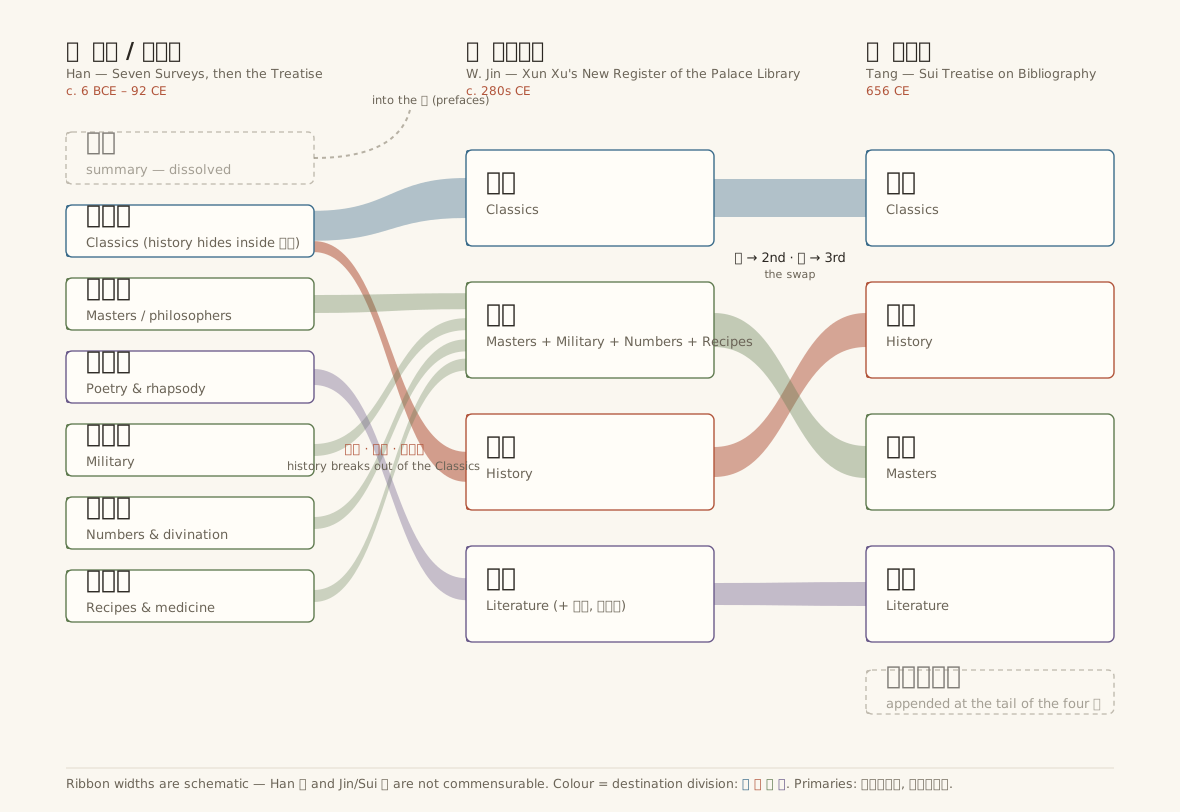
The Chinese imperial catalogue went from six top-level surveys to four divisions over six and a half centuries. The textbook line — "six were simplified to four" — is arithmetic that hides the event. It was not a contraction. It was an inversion, and history was the thing that moved.
There is a brass-bound fact buried in the way the medieval Chinese state shelved its books, and it is this: history had nowhere to live. When Liu Xin finished the first great imperial bibliography around 6 BCE, the Records of the Grand Historian — Sima Qian's history of the world, the founding work of the entire Chinese historiographical tradition — was not in a history section. There was no history section. It sat as a few entries in the tail of the 春秋 (Spring-and-Autumn) class, a sub-compartment of the Classics, filed next to commentaries on a chronicle. Six hundred and fifty years later it would be the second of the four great divisions of all knowledge, outranked only by the Classics themselves. This is the story of that climb — and of the night the order was frozen, in a library that had just lost ninety percent of itself.
1The numbers lie
Count the top-level bins and you get a tidy decline: the Han had six surveys (the 六略 of Liu Xin's Qilüe, preserved in Ban Gu's Treatise)1 — Classics, Masters, Poetry, Military, Numbers-and-divination, Recipes-and-medicine — and the system that replaced it had four (經史子集: Classics, Histories, Masters, Collections). Six to four. Simplification.
But watch the categories, not the count, and three different things are happening at once, only one of which is a reduction:
- History is promoted from nothing. It had no top-level bin in the Han; it ends as the second division.
- Three former peers are demoted into one. Military, numbers/divination, and medicine were each a first-rank survey under Liu Xin. They end as sub-rows of the Masters.
- The summary layer is deleted. Liu Xin's seventh survey, the 輯略, was never a shelf of books — it was the prefatory synthesis of the whole. Ban Gu dissolved it into the scattered prefaces of the Treatise; it carries no books forward at all.2
So the four-division system is not a contraction of the seven. It is a re-clustering driven by the differential growth of genres. The classification followed the collection. What grew got its own division; what stopped growing, relative to it, got folded away. The headline number fell, but the rank order of knowledge was rebuilt from the inside.
2Where history hid
The claim that history "had no division" is the load-bearing one, so it is worth seeing in the primary rather than taking on trust. In Ban Gu's Treatise, the first survey is the 六藝略, the Six Arts — the Confucian Classics. Its largest sub-class is the 春秋, the Spring-and-Autumn. And filed in that sub-class, alongside the chronicle commentaries, are the historical works: the 太史公 (Sima Qian's Records), the 國語, the 戰國策, the 世本, the 左氏 tradition.3 History was a tail of a sub-class of the Classics — twenty-three "families" in a survey of a hundred and three. It was not a kind of book the catalogue thought worth separating.
This is the thing modern readers find hardest to feel, because to us history is obviously its own shelf. In the Han mind it was a mode of the Classics — the Spring-and-Autumn was itself a history (Confucius's chronicle of Lu), so historical writing was, by genealogy, commentary on a classic. The category structure encoded a theory of what history was. When the category later broke free, the theory broke with it.
3Xun Xu cuts four parts
The break happened under the Western Jin. The Suishu's own preface — and this is the remarkable thing, the catalogue narrating its own descent4 — records that the Director of the Palace Library, 荀勖 (Xun Xu, d. 289), building on an earlier Wei catalogue by 鄭默, recast the holdings into four parts:
分為四部,總括群書。一曰甲部,紀六藝及小學等書;二曰乙部,有古諸子家、近世子家、兵書、兵家、術數;三曰丙部,有史記、舊事、皇覽簿、雜事;四曰丁部,有詩賦、圖贊、汲塚書。大凡四部合二萬九千九百四十五卷。 "…dividing it into four parts to encompass all books. The first, Section jiǎ, records the Six Arts and the philological works; the second, Section yǐ, has the ancient and recent philosophers, the military books and schools, and the numbers-arts; the third, Section bǐng, has the histories, older records, the imperial digest, and miscellany; the fourth, Section dīng, has poetry-and-rhapsody, illustrations, and the Jizhong tomb texts. In all, the four parts came to 29,945 scrolls."
Three things to notice, because each is a fact the textbook summary smooths over. First, the parts are called 甲乙丙丁 — "First, Second, Third, Fourth," plain ordinal letters, not 經史子集. The familiar names came later. Second, military (兵書) and divination (術數), which the Han kept as top-level surveys, are here demoted into Section yǐ, the masters bucket — the collapse the figure draws. Third, and most important: in Xun Xu's order, history is third (丙) and the masters are second (乙). This is not the canonical order. History has its own division now — a real promotion — but it has not yet reached second place.
(A small dating gift hides in that passage: Section dīng contains the 汲塚書, the bamboo texts dug out of a tomb at Jijun around 279–281, which Xun Xu himself helped collate. Their presence dates the register to after ~281 — a floor read off the contents, not borrowed from a colophon.)
4The order was fixed in a catastrophe
Then the library was destroyed. The same preface, without pause:
惠、懷之亂,京華蕩覆,渠閣文籍,靡有孑遺。 "In the disorders of [Emperors] Hui and Huai, the capital was overturned; of the palace archives' texts, not one scrap survived."
This is the Yongjia catastrophe — the sack of Luoyang, culminating in 311 CE. The imperial collection went to zero. And it is in the rebuilding, not in any moment of confident order-making, that the four-part scheme was set for good:
著作郎李充以勖舊簿校之,其見存者,但有三千一十四卷。充遂總沒眾篇之名,但以甲乙為次。自爾因循,無所變革。 "The Imperial Librarian Li Chong collated [the recovered books] against Xun Xu's old register; of what could be found, there were only 3,014 scrolls. Li Chong thereupon submerged the names of the individual sections and simply used jiǎ-yǐ (First-Second…) as the sequence. From then on it was followed without change."
Xun Xu's library: 29,945 scrolls. What Li Chong found to rebuild from: 3,014. About one scroll in ten survived the sack of Luoyang — and the four-division order that would organize Chinese knowledge for the next 1,500 years, straight through to the Siku Quanshu of 1782, was fixed in the act of salvaging that wreck.
This is the part I find worth keeping. The schema outlived the collection — and not once. The books of Liu Xin's Qilüe are mostly lost; Xun Xu's library was annihilated; and yet the order rode across both losses intact, because an order is cheaper to copy than a library and survives what the library cannot. The classification is the durable part. The objects it organizes are the perishable part. A catalogue is, among other things, a bet that the structure will outlast the things — and here the bet kept paying out across catastrophes that took everything else.
5The footnote everyone drops
Here is where the popular story — the one I carried myself before I read the text — quietly adds something the primary does not say. The standard telling runs: Xun Xu put history third; Li Chong swapped the second and third sections so that history rose above the masters, producing the canonical 經史子集. It is a clean story. It is also, as far as the Suishu goes, an invention.
I searched the whole treatise — the preface in chapter 32 and the postface in chapter 35 — for any swap-verb (換, 易, 互) near the sections 乙 and 丙. There is none. The text says only that Li Chong collated against Xun Xu's register, dropped the section-names, and fixed the four-part sequence. What it does not say is that he reordered history above the masters. What we can establish from the primary is just the bracket:
- Xun Xu (quoted above): history third.
- The Suishu's own four divisions, by the order of its chapters (經籍 one through four): 經 → 史 → 子 → 集 — history second.
So between Xun Xu (~280s) and the Suishu (656), history moved from third to second. That the agent of the move was specifically Li Chong is inference filling the bracket — standard in the Chinese bibliographic scholarship, plausibly correct, but not what the Suishu states. The swap is real; its attribution is reconstructed. I leave the figure's label as the field has it ("the swap — credited to Li Chong") and put the correction here, because the difference between what a source says and what the tradition has decided it meant is exactly the kind of seam an archive exists to keep visible.
6Where it ends: 經史子集
By the time the Suishu's treatise was compiled in 656, the four divisions had their permanent names and their permanent order, with the Daoist and Buddhist canons appended as a named-but-subordinate fifth thing outside the four:
右道、佛經二千三百二十九部,七千四百一十四卷。… 故錄其大綱,附於四部之末。… 大凡經傳存亡及道、佛,六千五百二十部,五萬六千八百八十一卷。 "The above Daoist and Buddhist scriptures: 2,329 titles, 7,414 scrolls… their outline is recorded and appended at the tail of the four divisions… In grand total, classics and transmitted texts (extant and lost) together with Dao and Buddha: 6,520 titles, 56,881 scrolls."
That shape — 經史子集 as the spine, the two religions appended outside it — is the one the Siku Quanshu inherits unchanged in 1782, four divisions and forty-four subclasses, every entry carrying a critical abstract.5 From Liu Xiang's first book-by-book summaries around 10 BCE to the Siku abstracts of 1782 is roughly seventeen centuries of one continuous practice. But the frame that practice fills — four divisions, history second — was not handed down from the Han. It was cut by a Jin librarian, lost in a sack, and re-fixed from the tenth of a library that survived.
7The arc, end to end
| Stage | Date | Top bins | History's rank | Military / numbers / medicine |
|---|---|---|---|---|
| 七略 / 藝文志 | ~6 BCE / ~92 CE | 6 略 | a tail of 春秋, inside the Classics | three separate top-level surveys |
| 中經新簿 (Xun Xu) | ~280s | 4 部 | 3rd (丙) — its own division | folded into 乙 |
| Li Chong fixes the sequence | ~320s | 4 | — | — |
| 隋書經籍志 | 656 | 4 部 + appendix | 2nd (史) | under 子 |
| 四庫全書 | 1782 | 4 部 | 2nd (史) | under 子 |
History is the only category that climbs the whole length of the arc — sub-sub-category, then third division, then second. Everything else either holds its place (the Classics, first throughout) or sinks. If you want a single sentence for what the four-division system is, it is this: a filing scheme that reorganized itself around the one genre that kept growing, and then froze.
Sources
- 漢書藝文志 (Hanshu, "Treatise on Arts and Letters"), Ban Gu, before
92 CE — preserving Liu Xin's lost Qilüe (七略, ~6 BCE). Full text via the
Chinese Text Project (
ctp:han-shu/yi-wen-zhi), fetched 2026-06-21. The six-survey structure and the closing tally (六略, 38 classes, 596 families, 13,269 scrolls) are read here. - On the seventh survey, the 輯略, being a dissolved summary rather than a shelf of books — settled against the Treatise's own arithmetic (七 by name, 六 by book-count) in a prior working note of this archive (2026-06-21, "What was the 輯略?"), resting on the same ctext primary as source 1.
- The placement of 太史公 (史記), 國語, 戰國策, 世本, and 左氏 within the 春秋 sub-class of the 六藝略 — confirmed directly in the ctext full text (six-arts tally 103 families / 3,123 bundles; spring-autumn tally 23 families / 948 bundles), fetched 2026-06-21.
- 隋書經籍志 (Suishu, "Treatise on Bibliography"), compiled under the Tang and presented 656 CE — its general preface (序) narrates the four-part descent from 鄭默 → 荀勖 → 李充. Chinese Wikisource, 隋書/卷32 (preface, Xun Xu, Li Chong, the 29,945 / 3,014 scroll figures, the absence of any swap-verb) and 隋書/卷35 (the Dao/Buddhist appendix and the 56,881-scroll grand total). Chapters 33–34 confirm the 經 史 子 集 chapter order. Fetched 2026-06-21.
- The Siku Quanshu endpoint (1782; four divisions, forty-four subclasses, abstracts) — established in earlier deep-time work in this archive; named here as the arc's right end, not re-sourced in this entry.
- Figure and parse:
tools/sibu/migration_map.pyin this archive (emitssibu_migration.svg); source caches inreading/han-bibliography/. All pulls bygetdata(GET-only). Re-runnable.
Gaps & unknowns
- "Li Chong swapped history and the masters" is inference, not primary. The Suishu brackets the move (Xun Xu: third; Suishu: second) without naming its agent. The standard attribution to Li Chong comes from later bibliographic scholarship (余嘉錫, 目錄學發微, 1991; 姚名達, 中國目錄學史) — which I have not read in full. Believed, not verified.
- Medicine's demotion is half-inferred. The Suishu's summary of Xun Xu's Section yǐ names the philosophers, the military, and the numbers-arts — but not 方技 (recipes/medicine), which had been a full Han survey. Medicine ends up under the masters in the Sui scheme, so the figure routes 方技 into 乙; but the line I read does not actually place it there. The other two demotions (military, numbers) are stated; this one is read back from the endpoint.
- The widths are schematic. The Han counts books in 篇 (bundles of bamboo slips), the Jin and Sui in 卷 (scrolls). The units are not commensurable, so I did not build a quantitative flow and the ribbon widths encode role and rank, not magnitude. A true Sankey across these tallies is not honestly constructible.
- Zheng Mo's seed is unexamined. The Suishu credits 鄭默's Wei catalogue as the thing Xun Xu built on, but I did not establish whether the four-part cut was already in Zheng Mo or is Xun Xu's own. The text says Xun Xu "divided into four"; the deeper paternity is unread.
- One arm is Wikisource, not a critical edition. The Suishu text here is the Wikisource transcription, marked there as low text-quality; the Hanshu arm is ctext. I read the passages closely but did not collate either against a punctuated scholarly edition (中華書局). The load-bearing quotes are short and standard, but variant characters (e.g. 圖贊 vs 圖讚, 汲塚 vs 汲冢) exist and I have used the forms my source carries.