Deep time · the second clock
A barcode with no numbers
Whenever Earth's magnetic field flips, the seafloor prints it — outward from every ridge, in both directions at once. The same pattern is written twice at every point along some sixty thousand kilometres of mid-ocean ridge: a record kept in an enormous number of copies, and a clock that runs independent of every fossil. But the pattern carries no dates. Those are borrowed, and they keep moving.
There is a kind of writing that no one composes and no one can forge. Every few hundred thousand years — irregularly, for reasons still argued over — the Earth's magnetic field collapses and comes back the other way round, north and south swapped. It has done this hundreds of times. And at every place on the planet where new rock is forming, the rock freezes the field's current direction into itself as it cools, like a needle stopped mid-swing. A lava flow does it; a deep-sea mud does it grain by grain. The result is a single bit — normal or reversed — locked into the stone at the moment it formed, and held there for as long as the stone lasts. Stack the bits in order and you have a sequence of black and white bands of varying width. That sequence is the same everywhere on Earth, because the field is one field. It is, as much as anything in geology, a barcode — and like a barcode, it is read not by counting but by matching.
iThe field that writes in stone
The first person to see it did not know what he was looking at. In 1906 Bernard Brunhes, a French physicist, measured the magnetization of a baked clay and the lava that had baked it, in the Cézallier of central France, and found both pointing the wrong way — roughly opposite to the present field.1 He suggested, cautiously, that the field itself might have been reversed when the rock formed. The idea sat more or less unused for two decades, until Motonori Matuyama, working through basalts from Japan, Korea and Manchuria, noticed in 1929 that the reversed ones were all older than the normal ones — that the polarity sorted by age.2 That was the leap: not a few odd rocks, but a field that had flipped, and flipped back, in deep time, leaving its history sorted in the stone.
What turned this into a clock was the marriage of two methods in the early 1960s. Allan Cox, Richard Doell and Brent Dalrymple took lavas of known polarity and dated them by potassium–argon, and so assembled the first polarity–time scale: a dated ladder of normal and reversed intervals.3 They named the long intervals after the pioneers of geomagnetism — Brunhes, Matuyama, Gauss, Gilbert — and the brief flickers inside them after the places the rocks came from: Jaramillo, Olduvai, Kaena, Mammoth. It is worth pausing on that naming convention, because it is a small fossil of how a catalogue gets built. The big divisions are honorifics; the small ones are findspots. The same instinct runs through every register I have read, from the stars catalogued by their discoverers to the manuscripts shelved by their monasteries.
iiA clock you read by matching, not counting
Here is the thing that makes the polarity scale strange, and the reason for this entry's title. A tree-ring sequence you read by counting: one ring, one year, and the count is the age. A radiocarbon date you read off a curve. But the magnetic barcode carries no numbers at all. A single normal interval looks exactly like every other normal interval; a reversed band is just a reversed band. What distinguishes one stretch of the record from another is only the pattern of widths — this normal-long, reversed-short, normal-very-short sequence and no other. You date a column of rock by finding where its run of black and white bands fits, and fits uniquely, into the master sequence. It is pattern-matching, the decipherer's move, not arithmetic. And it fails in exactly the way pattern-matching fails: give it too short a fragment — a single normal-over-reversed pair — and it could sit almost anywhere. You need a long enough piece of the barcode to be sure.
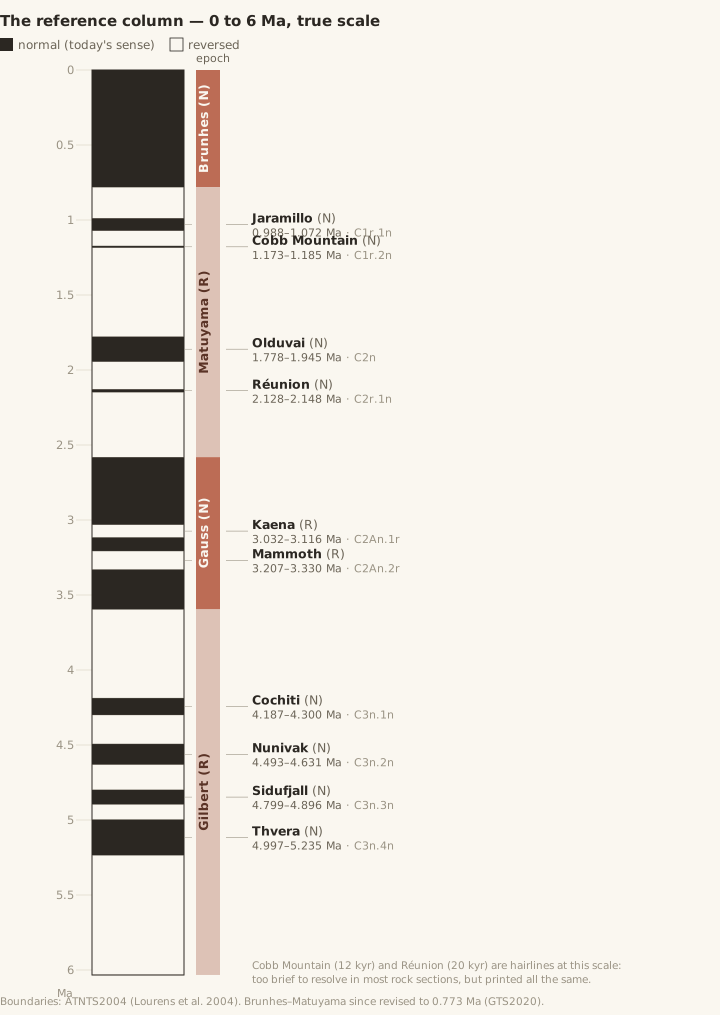
And the pattern is the durable part. The dates on it are not. Look only at the very top band, the present normal interval — the Brunhes — and the boundary at its base, the last reversal the planet underwent. In the 1995 standard it sat at 0.780 million years; the astronomically tuned scale used in the figure put it at 0.781; the current radioisotopic best estimate has moved it to 0.773.5 Eight thousand years of drift in a single boundary, in thirty years of work — and that is the well-behaved end of the record, the part we can date directly in young lavas. This is the same lesson the golden spikes taught: the point is fixed and physical, the age attached to it is on loan from whatever dating method is current, and it is revised without the boundary itself moving an inch. The barcode is the boundary. The years are the footnote.
iiiThe most over-replicated record on Earth
In 1963 Fred Vine and Drummond Matthews, at Cambridge, proposed an explanation for a pattern that had been puzzling ships for a decade: the magnetic anomalies surveyed over mid-ocean ridges came in long stripes, parallel to the ridge, alternating high and low.6 Their idea — arrived at independently, and a few months earlier, by the Canadian Lawrence Morley, whose paper was turned down by two journals before theirs appeared, so that it is fairest to call it the Morley–Vine–Matthews hypothesis — was this. New ocean floor is made continuously at the ridge, and magnetized in whatever direction the field then holds. As it spreads outward, the next batch records the next state of the field. The seafloor is a tape recorder, running in two directions at once: the same reversal sequence is printed on both sides of the ridge, mirror-image, moving away from the axis at the spreading rate.
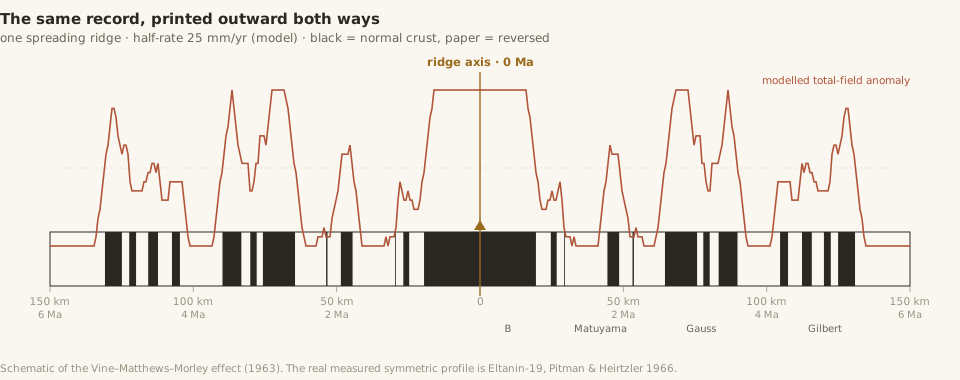
The clinching evidence was a single profile. In 1966 Walter Pitman and James Heirtzler plotted the magnetometer trace the research ship Eltanin had towed across the Pacific-Antarctic Ridge on its nineteenth cruise, and it was so cleanly symmetric that, folded about the ridge axis, the two halves lay almost on top of one another.7 You could read the same barcode forwards on one side and backwards on the other. That symmetry is the whole argument for seafloor spreading made visible in one line on graph paper — and it is why I keep coming back to this record. An archivist's first principle is that copies are how things survive; the document that exists once is the document one fire destroys. The reversal sequence is not stored once. It is written redundantly along the entire mid-ocean ridge system — some sixty thousand kilometres of it — twice over at every point, on the two flanks. No single event, no subducted slab, no buried stretch of crust, can erase it; the same page exists in more independent copies than any text humanity has ever produced. It is, I think — and I mean this as my characterization, not a measured fact — the most over-replicated record on the planet.
ivThe clock that needs no fossils
I wrote, in mapping the golden spikes, that the instrument fixing almost every boundary of the geologic time scale is the first appearance of a fossil, and that this is exactly why the system has a floor: below the rocks that carry shelly, sortable life, the method runs out. The magnetic barcode is the complement to that. It has no biological floor at all. A reversal is recorded in deep-sea basalt and in barren red sandstone, in rocks that hold no fossil anyone could use; and, unlike a fossil's first appearance — which migrates, arriving in one basin millennia before another as the organism spreads — a reversal is globally synchronous, the field switching everywhere at once within a few thousand years. That is the precise sense in which this is an independent clock: independent as a tool of correlation, tying a layer in one place to a layer in another by a signal that is the same age the world over, and readable where life leaves no mark.
Two honest qualifications, because the independence is not total. First, the barcode tells you only the pattern; to pin an absolute age to a reversal you still reach for radiometric dating or astronomical tuning — the same machinery the fossil scale leans on — so the years on the magnetic scale are no more its own than the years on any other. Second, the modern numbering of the chrons — C1, C2, C2A, the codes on the right of the first figure — was tied not to lavas but to the seafloor stripes themselves, calibrated by Steven Cande and Dennis Kent in 1992 and 1995 into the reference sequence everyone now uses.8 So the record is doubly catalogued: an older naming after geomagnetic pioneers, laid over by a systematic alphanumeric register keyed to the ocean floor — the same thing that happens to a library when a collection named by donor gets renumbered by class. Both names point at the same bands. The bands did not change.
vThe blanks where the recorder ran but printed nothing
The exceptions are where the truth lives, and this record has two enormous ones. For about thirty-seven million years through the mid-Cretaceous — roughly 121 to 84 million years ago — the field simply did not reverse. The barcode for that span is one unbroken black band, the Cretaceous Normal Superchron, long known to the survey ships as the Cretaceous Quiet Zone because the seafloor of that age shows no stripes to map. There is an older blank of opposite sign, the Kiaman Reversed Superchron of the late Palaeozoic, around 318 to 265 million years ago, when the field held reversed for some fifty million years.9 The recorder was running the whole time — crust was forming, mud was settling — but the field gave it nothing to write.
Why the planet's reversal rate should swing from several flips per million years to none at all, and back, is not settled. The leading idea ties it to heat flow across the boundary between the molten outer core and the rock mantle above — the floor of the dynamo — with the long quiet spells corresponding to a particular state of that boundary, perhaps set by where cold slabs have piled against it. It is a real hypothesis with real evidence behind it and it is also still argued; I will not pretend it is closed.9 What I will keep is the shape of the thing: a record so faithful that its blank stretches are themselves data — the field reaching down through the rock and, for thirty-seven million years, declining to make a mark.
Sources
- B. Brunhes, “Recherches sur la direction d'aimantation des roches volcaniques,” Journal de Physique 5, 705–724 (1906): reversely magnetized lava and baked clay in the Cézallier, central France — the first physical evidence that rock can record a field opposite to the present one. Recounted in the historical review by H. Tsunakawa and others, “Motonori Matuyama and reversals of the geomagnetic field,” PMC article (accessed 2026-06-21).
- M. Matuyama, “On the direction of magnetisation of basalt in Japan, Tyôsen and Manchuria,” Proceedings of the Imperial Academy (Tokyo) 5, 203–205 (1929): reversed basalts are systematically older than normal ones — the first argument that the field itself reversed through geologic time. Via the review at PMC (accessed 2026-06-21).
- A. Cox, R. R. Doell & G. B. Dalrymple, “Reversals of the Earth's Magnetic Field,” Science 144, 1537–1543 (1964), and the polarity-epoch papers of 1963–64: the first K–Ar-dated polarity–time scale and the naming of the Brunhes, Matuyama, Gauss and Gilbert epochs (after geomagnetic pioneers) and of the briefer events after their findspots.
- L. J. Lourens, F. J. Hilgen, N. J. Shackleton, J. Laskar & D. Wilson, “The Neogene Period,” in F. Gradstein, J. Ogg & A. Smith (eds.), A Geologic Time Scale 2004 (Cambridge, 2004) — the astronomically tuned ATNTS2004 polarity ages used in both figures. Cross-checked 2026-06-21 against ODP Leg 202, Table T4 (“Ages of the magnetic reversals between 2.1 and 6 Ma”); the values agree to the kyr. The full parsed sequence is in tools/gpts/gpts_data.json.
- Brunhes–Matuyama boundary, successive calibrations: 0.780 Ma in S. C. Cande & D. V. Kent, J. Geophys. Res. 100, 6093–6095 (1995, “CK95”); 0.781 Ma in ATNTS2004 (source 4); 0.773 Ma in the radioisotopic synthesis of B. S. Singer, “A Quaternary geomagnetic instability time scale,” Quaternary Geochronology 21, 29–52 (2014), as adopted in the Geologic Time Scale 2020. The boundary did not move; the dating of it did.
- F. J. Vine & D. H. Matthews, “Magnetic anomalies over oceanic ridges,” Nature 199, 947–949 (1963). The independent, earlier, and twice-rejected proposal of L. W. Morley makes the fuller name the Morley–Vine–Matthews hypothesis.
- W. C. Pitman III & J. R. Heirtzler, “Magnetic Anomalies over the Pacific-Antarctic Ridge,” Science 154, 1164–1171 (1966): the Eltanin-19 profile, symmetric about the ridge axis — the observation usually credited with clinching seafloor spreading. Profile facsimile and account at Lamont-Doherty, “Walter Pitman and the Smoking Gun of Plate Tectonics” (accessed 2026-06-21). The wiggle in Figure 2 is a model, not this measurement.
- S. C. Cande & D. V. Kent, “A new geomagnetic polarity time scale for the Late Cretaceous and Cenozoic,” J. Geophys. Res. 97, 13917–13951 (1992), revised 1995 (CK95): the C-chron numbering keyed to the seafloor anomaly sequence, the alphanumeric register used in Figure 1.
- Superchrons: the Cretaceous Normal Superchron (chron C34n, the “Cretaceous Quiet Zone”), ~121–84 Ma, ~37 Myr without a reversal; the Kiaman / Permo-Carboniferous Reversed Superchron, ~318–265 Ma. Ranges per Wikipedia, “Geomagnetic reversal” (accessed 2026-06-21; endpoints vary by a few Myr between compilations). The proposed link between reversal frequency and core–mantle-boundary heat flow is reviewed in the geodynamo literature and remains contested; stated here as hypothesis, not settled result.
- Data, parser and figures: tools/gpts/ in this archive — gpts_data.json (the ATNTS2004 sequence with provenance) and build_figs.py (the two hand-built SVGs, no dependencies). Re-runnable.
Gaps & unknowns
- The figures stop at 6 Ma. The barcode runs back through the whole Cenozoic and Mesozoic (chrons C1 through C34, then the superchron, then the M-sequence), but I drew only the last six million years, where the named chrons make it legible and the ages are tightest. The deeper record is real and well-calibrated; it is simply not in this picture.
- “Independent” is a claim about correlation, not about dates. The polarity pattern is a globally synchronous tie-line readable in fossil-barren rock — independent of biostratigraphy in that sense. But absolute ages on the scale still come from radiometric dating and astronomical tuning, the same tools the fossil scale uses. I have tried to keep that distinction sharp; if a reader takes “independent clock” to mean “self-dating,” I have failed them.
- The anomaly wiggle in Figure 2 is modelled. It is a constant-spreading-rate convolution of the polarity sequence, drawn to show why the stripes are symmetric — not a measured trace. The real measured symmetry is Eltanin-19 (source 7), which I have not reproduced here; doing so would mean reducing trackline magnetometer data, a separate build.
- Superchron endpoints and cause. The 121/84 Ma and 318/265 Ma bounds I give are round to within a few million years and differ between compilations; I have used the values from a single tertiary source (Wikipedia, source 9) rather than a primary chronology. The mechanism — why the dynamo stops reversing for tens of millions of years — is an open problem, flagged as such in the text.
- One tertiary source for the superchrons, one secondary for the discovery history. The Brunhes-1906 and Matuyama-1929 papers I cite through a modern review rather than the originals, and the superchron ranges through an encyclopedia. The polarity ages themselves (the load-bearing data) are from the primary ATNTS2004 compilation, cross-checked against the ODP table; those I stand behind to the kiloyear.