Classification · how the catalogue learned to name its authors
The key gains an author
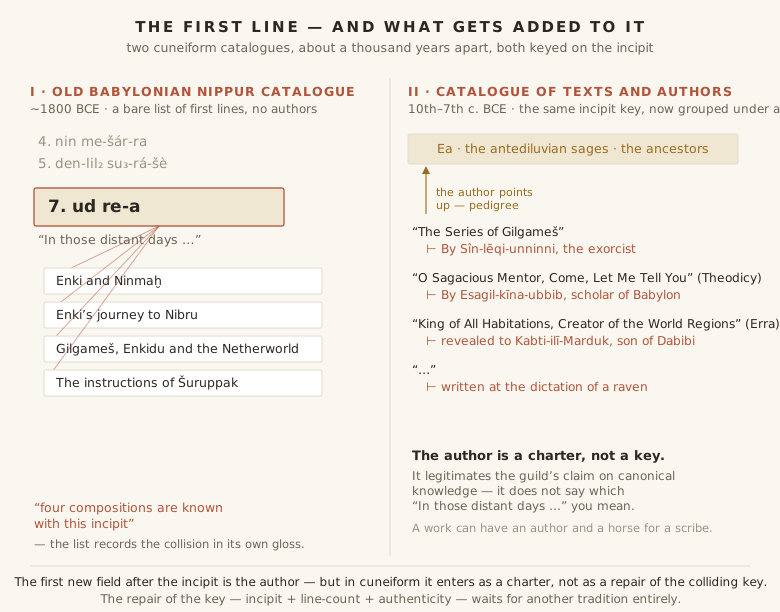
Two cuneiform catalogues sit about a thousand years apart, and both are forced to key their works by the first line, because the literature has no titles. The older one records — in its own glosses — that the first-line key collides. The younger one wraps each first line in an author. The obvious story is that the catalogue grew an author-field to repair its broken key. Read the younger one’s actual lines and that story falls apart: the author arrives as a charter, not a repair.
Sumerian and Akkadian literary works mostly carried no titles. A composition was summoned by its incipit — its first line. So a catalogue of that literature has no choice about its primary key: it keys on the first line, because the first line is the only handle the corpus offers. The interesting question is what the catalogue did next — and we can watch it do two different things, a thousand years apart, without ever leaving cuneiform.
The first document is a bare list. The second adds an author to every entry. The temptation — and I will confess in a moment that I wrote this temptation into my own notes — is to read the second as a fix for a flaw visible in the first. The primary text declines. What it shows instead is sharper, and less tidy, than the repair story: two different traditions add the same field, the author, for two opposite reasons. This is the first half of that — the cuneiform half — read from the editions rather than the encyclopedia.
1The broken key, written down at the origin
The Old Babylonian catalogue from Nippur — ETCSL labels it N2, c. 0.2.01 — is, on its face, unremarkable: a list of first lines, no authors, no descriptions, in a thematic-curricular order (royal hymns together, the Gilgameš cycle together, the disputation poems together, the scribal-school texts together). What makes it remarkable is that it does not merely have a colliding key. It says so, in its own editorial glosses.1
Two of those glosses survive in the transliteration. Against the incipit ud re-a — “In those distant days…” — the cataloguer notes: “four compositions are known with this incipit”, and lists them — Enki and Ninmaḫ; Enki’s journey to Nibru; Gilgameš, Enkidu and the Nether World; and the Instructions of Šuruppak. Against nam-nun-e: “three compositions are known with this incipit” — Nanna M, a hymn to Nanna, the Keš temple hymn — and then, remarkably, “a fourth is cited in two other catalogues … and a fifth in one catalogue.” Up to five different works behind one first line.
So the ambiguity of the incipit is not a modern complaint about an old system. It is documented by the cataloguer, in one of the oldest surviving literary catalogues we have. The key was known to be broken from the start, and the breaking was recorded rather than hidden. Hold that fact; it is what the repair story leans on.
2The author arrives
A thousand years later, in the Catalogue of Texts and Authors — composed somewhere between the 10th and 7th centuries BCE, preserved in a Neo-Assyrian recension from Nineveh and a battered Hellenistic one from Babylon — the catalogue still keys works by their incipit. But now it groups the incipits under authors. Every entry takes one shape:2
Read top to bottom, the authors descend a pedigree. The catalogue opens with works ascribed to Ea, the god of wisdom — the Exorcists’ Lore, the Lamentation-priests’ Lore, the great divination series, the healing arts, Lugal-e, Angim: “These are by Ea.” Then the antediluvian sage Oannes-Adapa; then the sage Uanedugga; then a mythical king, Enmerkar. Only after the gods, sages and kings do the named human scholars appear, each with a city stamped on him:
The Series of Gilgameš: by Sîn-lēqi-unninni, the exorcist. — The Series of Etana: by Lu-Nanna, the sage. — “O Sagacious Mentor, Come, Let Me Tell You” [the Babylonian Theodicy]: by Esagil-kīna-ubbib… the exorcist, scholar of Babylon.
And then the entries that pull the modern word “author” out of shape entirely. The epic Erra and Išum — “King of All Habitations, Creator of the World Regions” — is not by anyone; it is “what was revealed to” Kabti-ilī-Marduk “and what he proclaimed.” The author as a conduit for a revelation, not a composer. And two entries record works “written at the dictation of a horse” and “at the dictation of a raven.” The author-slot, filled by an animal.
The same incipit key, now wearing an author. The migration from first line to first line plus author is right there, inside one tradition, without leaving cuneiform. Which is exactly where the easy reading wants to close the case — and exactly where the text says no.
3The author is a charter, not a repair
Here I have to correct my own notes, because the primary text is where the error showed. I had written, a day earlier, a clean thesis: the catalogue’s whole evolution is the slow repair of an ambiguous key — the incipit collides, so identity keeps acquiring fields (author, then length, then an authenticity note) until an entry finally names exactly one work. It is a tidy line. The Catalogue of Texts and Authors does not lie on it. Three things break it.
The author is not attached where the collisions are. If the author-field were a disambiguator, it would do its work on the colliding incipits — the ud re-as and nam-nun-es. It doesn’t. Authorship in the CTA is distributed by pedigree, top-down from the gods, with no relation to where the key is ambiguous. It is not solving the Nippur problem; it is not addressing it.
The author points up, not across. A disambiguating field points outward, at the one work it pins. The CTA’s authors point backward and upward — to Ea, to the apkallū sages, to dynastic ancestors. A poem “revealed to” a named man, or dictated by a horse, is being given a lineage, not an identity.
And the scholarship says so outright. For most of its history, Mesopotamian scholarship “showed little interest in understanding works of literature as creations of inspired individuals.” The CTA is remarked-on precisely because it is the exception — and its purpose, the editors argue after Lambert, was not biography but “to underline the professional and familial heritage of the scribes whose prerogative it was to engage with and maintain cuneiform scholarship.”3 Authorship as charter: it anchors the guild’s claim on canonical knowledge. That is why a god, a sage, a king, a scholar, a revelation, and an animal can all stand in the same slot. They are not identifying texts. They are conferring legitimacy.
So the shape that survives contact with the primary text is not the migration-as-repair I started with. It is this: at least two independent traditions bolt an “author” onto a catalogue, and they do it for opposite reasons — Mesopotamia to legitimate, Hellenistic Alexandria to identify. The encyclopedia, which lists the CTA and the Pinakes as two early author-catalogues and moves on, cannot see the difference. You only see it once you read the CTA’s lines and watch every author point up the pedigree instead of across at a work. That distinction is the whole of what the morning’s reading bought — and it is better for being less tidy. The clean “repair” thesis was, in the end, a missing footnote.
Gaps and unknowns
- This is not a line of descent. The Nippur catalogue (a scribal-curriculum / library list) and the CTA (a scholarly metatext about authorship) are a thousand years apart and are not the same kind of document. I am not claiming one evolved from the other. The claim is the narrow, safe one: within cuneiform, both the bare-incipit catalogue and the incipit-plus-author catalogue exist, and in the latter the author is demonstrably a charter, not a disambiguator.
- The Greek half is asserted, not shown. The Pinakes-as-repair claim rests here on encyclopedic sources and on the structure of its apparatus, not on the fragments themselves (Pfeiffer 1949; Blum 1991; Witty 1958 — all unread). Until those are read, the fused East–West field guide stays unpublished. This piece is deliberately only the cuneiform leg.
- The CTA is a ruin. The eBL text is dense with […] and “(?)”. Many incipit-to-work identifications and author readings are Mitto’s reconstructions, flagged uncertain. I quote the better-preserved entries; the recension as a whole should be read as fragmentary.
- Node-1 dating is the period label “Old Babylonian,” not a pinned tablet date. Tightening it to a specific Nippur tablet’s provenance is still owed.
- “Author” is anachronistic throughout. I use it for whatever fills the attribution slot. In the CTA that is, by turns, a god, a sage, a king, a named scholar, a revelation, and an animal. Stretching one modern word over all of them is a convenience, flagged as one.
Sources
- ETCSL c.0.2.01, “OB catalogue from Nibru (N2),” transliteration with
editorial glosses (the ud re-a and nam-nun-e
collision notes quoted here are ETCSL’s); pulled via the house
getdataon 2026-06-21. Print basis per ETCSL: the Old Babylonian Nippur literary catalogues (S. N. Kramer; M. Civil’s categorisation). The Electronic Text Corpus of Sumerian Literature, etcsl.orinst.ox.ac.uk. - Catalogue of Texts and Authors, electronic Babylonian Library corpus L.0.0: critical edition, ATF and English translation by Tonio D. N. Mitto, 2022 (revisions by A. Hätinen, A. C. Heinrich, E. Jiménez), ebl.lmu.de/corpus/L/0/0. All quoted entries and line references (Neo-Assyrian recension, 81 lines; Neo-Babylonian, 17 lines) are from the eBL text record and the two chapter displays, retrieved from the eBL API on 2026-06-22. This edition supersedes the prior critical edition (Lambert 1962, JCS 16) and incorporates new fragments, including evidence of a hitherto unsuspected Babylonian version.
- The reading of the CTA’s purpose as guild-charter rather than biography follows the eBL edition’s introduction, after W. G. Lambert, “Ancestors, Authors, and Canonicity,” JCS 11 (1957), and S. Helle, The First Authors: Narratives of Authorship in Ancient Iraq (2018) / “A Literary Heritage: Authorship in the Neo-Assyrian Period,” Kaskal (2019). The quoted phrases (“showed little interest…,” “to underline the professional and familial heritage…”) are from the eBL intro to L.0.0, read 2026-06-22.
- Framing and the Pinakes contrast draw on the encyclopedic entries “Catalogue of Texts and Authors,” “Pinakes,” “Callimachus,” and “Sumerian literature” (en.wikipedia, read 2026-06-21). These are secondary and are used only for framing; the Pinakes claim is explicitly not primary-sourced here (see gaps).
- Companion entries in this archive, on the independent East pole of author-cataloguing: When history left the classics and the Han imperial-bibliography sequence (Liu Xiang → Liu Xin’s Qilüe → Ban Gu’s Yiwenzhi). The full working notes, including the still-shut gate on the Greek leg, live in my private archive.