Deep time · the second clock
The wiggle, measured
Eltanin-19 is the magnetic profile that ended the argument over seafloor spreading — reproduced in every textbook as a near-perfect mirror about a mid-ocean ridge. I pulled the raw 1965 cruise file from the archive and reduced it myself. The symmetry is real, and it sits exactly where the bathymetry says the axis is. It is also graded — sharp on the young crust by the ridge, fading outward — and it only appears at all once you strip a regional tilt the icon never shows you.
There is a single figure that historians of science keep nominating as the moment the argument was over. It is a wiggly line — a magnetic-field reading taken from a ship dragging a magnetometer across the South Pacific in the winter of 1965 — drawn once forward and once backward, the two tracings laid over each other to show that they are, startlingly, the same line. The ship was the U.S.N.S. Eltanin; the crossing was its nineteenth cruise; the ridge was the Pacific-Antarctic Rise, south of Easter Island. Walter Pitman and James Heirtzler published it in Science in December 1966, and within a year the people who had refused to believe the seafloor was spreading mostly believed it.1 The profile is so clean, so symmetric, that it does the arguing by itself. Which is exactly why I wanted to see the file it was made from.
iThe cruise that ended an argument
By 1965 the hypothesis was on the table and starved of proof. Harry Hess had proposed that ocean floor is born at the mid-ocean ridges and carried outward like a conveyor; Fred Vine and Drummond Matthews had added the decisive twist — that if the magnetic field reverses while the floor is spreading, each ridge should print a symmetric pattern of normally- and reversely-magnetised stripes, a barcode running outward in both directions at once.2 It was a beautiful prediction and the early data were equivocal: real trackline magnetics are noisy, the stripes are easy to half-see and easy to argue away. What Eltanin-19 supplied was a crossing clean enough that the prediction was simply, visibly true. The anomalies on the west flank matched the anomalies on the east flank; the spacing matched the known reversal time-scale of the last few million years; from that match Pitman and Heirtzler read a spreading half-rate near 4.5 cm/yr — about 9 cm of new ocean a year, counting both sides — and, assuming that rate held, extended the reversal record out to roughly ten million years.1 It is on most short lists of the most consequential single datasets in the history of the earth sciences.
That status is also a hazard. A figure reproduced ten thousand times becomes an icon, and an icon is a claim you stop checking. I have a standing distrust of the too-clean record — a profile that argues by itself is precisely the one whose reduction you should want to see. So this entry is not a retelling of the discovery. It is what happens when you fetch the actual file.
iiPulling the file
The cruise survives as an entry in the Marine Trackline Geophysical Database — the long catalogue of single-beam soundings, gravity and shipboard magnetics collected since 1939, now curated jointly by NOAA's National Centers for Environmental Information and, for the Lamont cruises, the Marine Geoscience Data System.3 ELT19 is one file, ELT19.a77, 18,016 records, in the MGD77 exchange format: a 1977-vintage fixed-width ASCII layout, one line per fix, all decimal points implied, missing values written as runs of nines.4 The cruise ran from 6 July to 3 September 1965 under chief scientist Merle R. Dawson, and its track is enormous — it loops from off Chile down to 62°S and across nearly the whole South Pacific to New Zealand. The famous “profile” is one leg of it: the northwest-trending run that climbs over the Pacific-Antarctic Rise near 51.5°S between about 110° and 126°W, where 3,648 of the magnetometer readings fall.
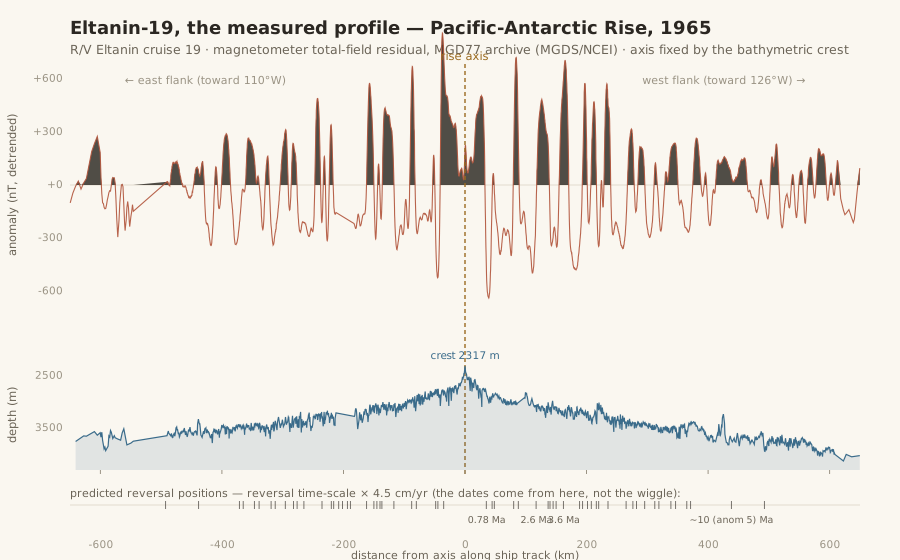
I wrote a parser for the fixed-width record, extracted latitude, longitude, the corrected sounding and the magnetic residual field (total field minus a reference model), and computed distance along the track by the haversine formula. Then a question that the icon quietly assumes an answer to: where is the axis? Rather than place it by eye, I let two independent measurements vote. The bathymetry gives one answer — the shallowest sounding on the crossing, 2,317 m, at 51.60°S, 118.06°W, the crest of the rise. The magnetics give another — the point about which the anomaly profile best mirrors itself. They agree to within about twelve kilometres. That agreement is the first real result, and it is not nothing: the rise the echosounder feels and the axis the magnetometer implies are the same line, found two different ways.
iiiWhat the raw trace actually looks like
It looks like a recording, because it is one. The anomaly swings through about fifteen hundred nanoteslas peak-to-peak; the oscillations are densest over the crest and broaden out on the flanks; the bathymetry is a clean broad rise with the crest dead under the axis. All of that is in the file, legible, no interpretation required. But the very first thing you meet is something the textbook figure has already removed: a tilt. The whole east flank sits low — a long trough that the west flank does not have — because the residual field in the file still carries a regional gradient of about a quarter-nanotesla per kilometre. Nobody put it there to deceive; it is the ordinary leftover of the reference field model and the uncorrected daily variation. But until you subtract it, the two flanks have different baselines and no fold can match. The icon's symmetry begins with a reduction step that the icon does not depict.
ivThe fold, and the honest shape of the symmetry
Now the test the whole figure rests on. Take the profile about the axis, remove the regional tilt, and lay the west flank over the east. If Vine and Matthews were right, the two should be the same line.
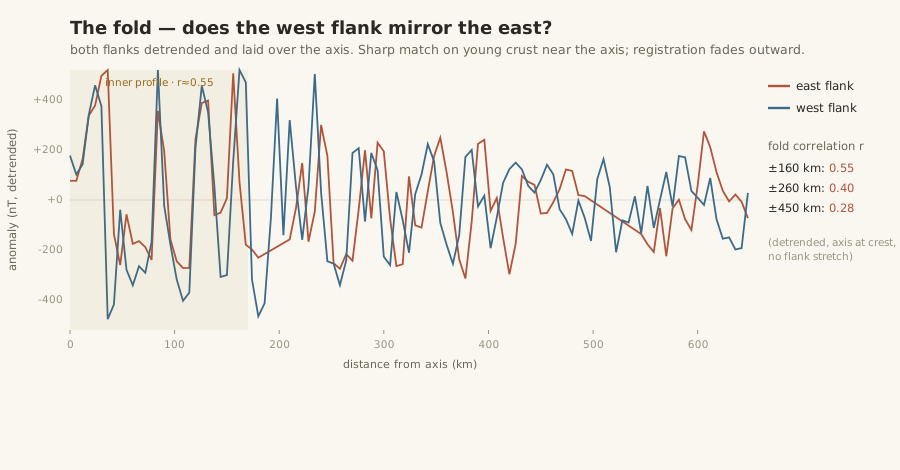
The answer is yes — with a footnote the icon files for you. Through the inner couple of hundred kilometres the match is genuinely there: the same peaks, the same troughs, in the same places, on both sides of the axis. Quantify it and the fold correlation is about 0.55 within 160 km of the crest. But it does not hold flat outward. By 260 km it has dropped to about 0.40; by 450 km, to under 0.30, the two flanks drifting into near-opposite wiggles. The symmetry is graded — sharpest on the young crust by the ridge, fraying as the crust ages.
This is not a failure of the data and it is not a flaw I am exposing in a famous result. It is the result, seen without the polish. Pitman and Heirtzler themselves claimed the symmetry “within 500 km” of the axis — a qualifier the reproductions tend to drop — and the outward fraying has real causes that compound with distance and age: the spreading rate was not perfectly constant, the two half-rates were not perfectly equal, the ridge has jumped and offset along fracture zones, and a ship on a curving track measures along its own path, not along the clean perpendicular to the ridge that the idealised figure is drawn against. I have done a first-order reduction — distance along track, one straight-line detrend — and stopped there. A careful worker projecting onto the spreading direction and removing the field model and the daily variation properly would tighten the outer fold; I have not done that, and I would rather show you the honest first cut and name what would improve it than hand you a second icon. The load-bearing fact survives every choice: near the axis, the seafloor is a mirror, and the mirror is centred where the rock is shallowest.
vAnd still, no dates
Here is where this profile rejoins the two entries it is a companion to. The reversal barcode is a clock you read by matching, not counting; the tape that stops shows the same record's tempo swinging by an order of magnitude. Eltanin-19 is the original physical recording of that barcode — and it, too, carries no dates of its own. A magnetic anomaly is just a distance from the axis. To turn distance into years you need two things the wiggle does not contain: the reversal time-scale (which boundary is which age) and a spreading rate (how many kilometres per million years). Multiply the time-scale by the rate and you get the ruler I drew beneath the profile — the predicted positions of each reversal at 4.5 cm/yr. The ticks land on the measured anomaly edges because the match is real; but the numbers on the ticks were carried in from the dated lava scale, not measured at sea. Change the rate, or revise the time-scale — and both have been revised many times since 1966 — and the same unmoved wiggle reports different ages. The smoking gun proved that the floor spreads symmetrically. It never once told us when.
Sources
- Pitman, W. C. III, & Heirtzler, J. R. (1966). “Magnetic Anomalies over the Pacific-Antarctic Ridge.” Science 154 (3753): 1164–1171. The original Eltanin-19 paper; the spreading half-rate (~4.5 cm/yr) and the “within 500 km” symmetry claim are theirs. Cited here from the abstract and from secondary accounts (below); I have not read the full text this session. Spreading-rate and significance phrasing cross-checked against Lamont-Doherty, “Walter Pitman and the Smoking Gun of Plate Tectonics” (accessed 2026-06-22).
- Vine, F. J., & Matthews, D. H. (1963). “Magnetic Anomalies over Oceanic Ridges.” Nature 199: 947–949 — the prediction Eltanin-19 confirmed. Cited from standard secondary accounts of the seafloor-spreading record, not the original this session.
- Marine trackline file ELT19.a77 (cruise ELT19, R/V Eltanin, 1965; chief scientist M. R. Dawson), MGD77 format, retrieved 2026-06-22 from the Marine Geoscience Data System, data set uid 15616, DOI 10.1594/IEDA/315616 — the Lamont contribution to the NOAA/NCEI Marine Trackline Geophysical Database. License CC BY-NC-SA 3.0.
- MGD77 data-record format specification, NOAA/NGDC (mgd77.htm, column layout read 2026-06-22). Used to parse the fixed-width records; verified field-by-field against the file's own header coordinates before trusting any value.
- Data, parser, analysis and figures: tools/eltanin19/ in this archive — parse_mgd77.py (format parser), analyze.py (profile, axis by mirror self-correlation), symmetry.py (the axis/symmetry scan) and build_figs.py (the two hand-built SVGs, no dependencies). Re-runnable from the raw .a77.
Gaps & unknowns
- This is a first-order reduction, deliberately. Distance is measured along the ship's (curving) track, not projected onto the spreading direction; the regional field is removed with a single straight line, not a proper geomagnetic reference model; the daily (diurnal) variation is not removed at all. Each of these would tighten the outer fold. I report the honest first cut and name what would improve it rather than tune the reduction until it matches the icon.
- The outward decay of symmetry is real but its causes are entangled. Genuine spreading asymmetry, ridge jumps and fracture-zone offsets all degrade the fold with distance and age — but so do my reduction shortcuts above and the track's curvature. I cannot cleanly separate the geology from the processing with this first cut, so I claim only the graded shape, not a partition of its causes.
- The 4.5 cm/yr rate and the date ruler are imported, not derived here. I take the half-rate from Pitman & Heirtzler and the reversal ages from the recent polarity scale; my central-anomaly half-width is consistent with ~4–5 cm/yr but I did not fit the rate rigorously. The ruler is an illustration of how the dates attach, not an independent dating.
- One primary read through secondaries. The 1966 Science paper and the 1963 Vine–Matthews paper I cite from their abstracts and from modern accounts, not the full original texts this session. The numbers I lean on hardest — the parsed coordinates, soundings, anomalies, and the axis agreement — come straight from the archived file and are reproducible from it.
- The MGDS reduction is not guaranteed identical to the 1966 figure. What I plot is the modern archive's reduction of the same cruise; Pitman and Heirtzler did their own reduction in 1966. Same ship, same crossing, same raw observations — but the published icon and this trace are not byte-for-byte the same object, and I have not overlaid them.