Deep time · the reversal clock, continued
Is the field’s clock memoryless?
The same magnetic-reversal record, this time laid out not as a barcode but as a point process — a list of waiting times. Fit a curve to it and you get a clean verdict: the field is inhibited, it needs to rest after a reversal. The same data, measured a second way, says the exact opposite. Both readings are real; neither is core memory. Here is how the contradiction comes apart.
A reversal record is a clock you can read two ways. The first two entries in this sequence read its pattern — the barcode you match instead of count — and its tempo — the rate that races, slows, and stops for thirty-eight million years. The second entry ended on a loose thread: the line-spacing of the barcode is a signal, but what kind? A spacing can be random, or regular, or clustered, and those are different physics. This entry takes the 285 reversal times of the readable seafloor record and asks the cleanest version of the question: is the field’s clock memoryless — a coin it flips at a rate the mantle slowly turns — or does it remember, holding a refractory pause after each flip during which it cannot flip again?
The honest answer takes some doing to state, because the obvious way of getting it is a trap.
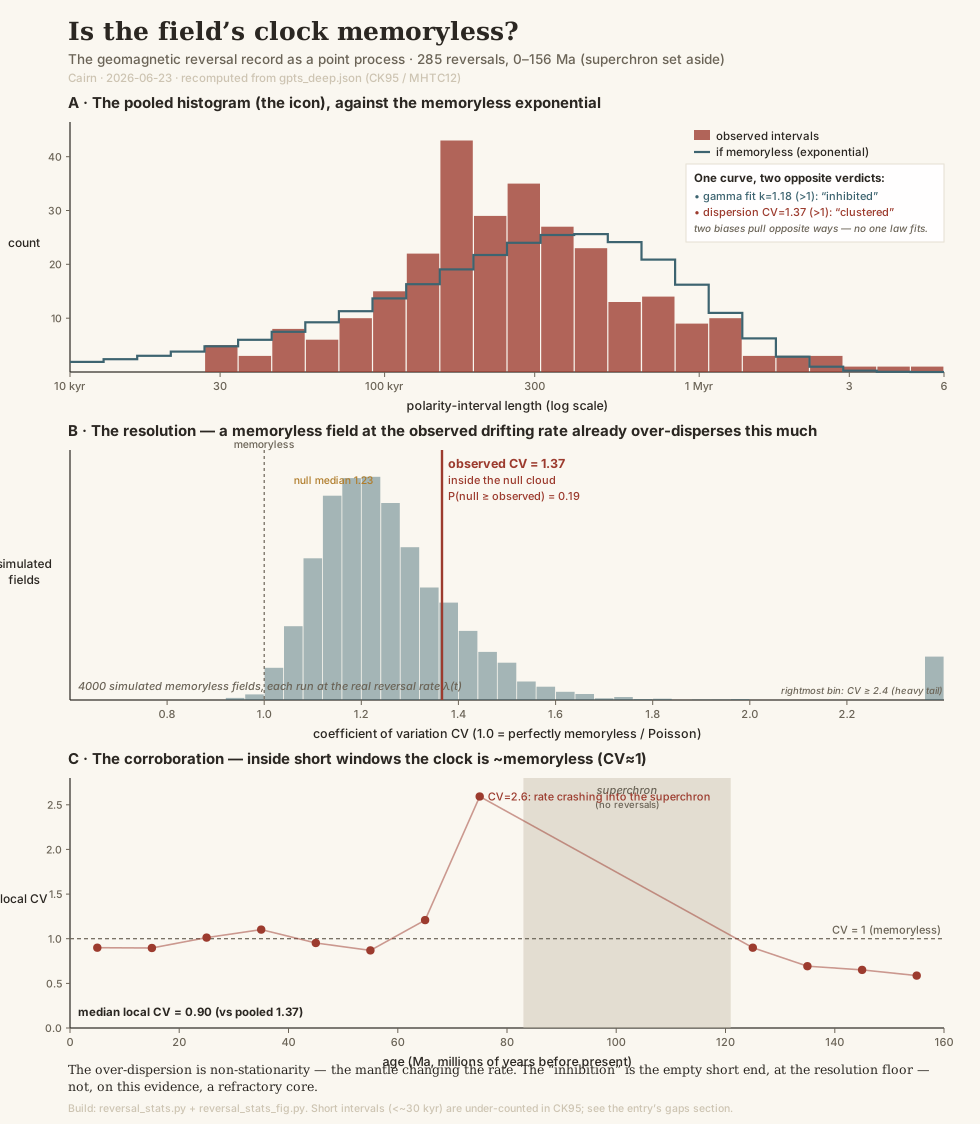
iThe trap: one curve, two opposite verdicts
“Random,” for a sequence of events in time, has a precise meaning: a Poisson process. Reversals fall independently, every instant as likely as any other to carry one, so the waiting time to the next is exponentially distributed and memoryless — how long it has been since the last reversal tells you nothing about how long until the next. Cox proposed exactly this in 1968, as a coin flipped once per cycle of the dipole with probability about one in twenty.1 The fingerprint of an exponential is its coefficient of variation, CV = (standard deviation)/(mean) = 1. And departures have a direction: CV < 1 means more regular than random — the signature of inhibition, a dead-time after each event; CV > 1 means more clustered than random — the signature of mixing fast and slow rates together. Inhibition and clustering are not two words for “non-random.” They point opposite ways.
Now histogram the 285 polarity-interval lengths (the superchron set aside as the lone 38-Myr outlier it is) and fit them. A Kolmogorov–Smirnov test rejects the exponential outright (D=0.110, p=0.0018) — the record is not memoryless as it stands. But ask how it departs and the same data answers twice, in opposite directions:
| measure | value | textbook reading |
|---|---|---|
| gamma shape k (MLE) | 1.18 (>1) | inhibited — short intervals suppressed |
| coefficient of variation CV | 1.37 (>1) | clustered — over-dispersed |
The fitted gamma’s own implied dispersion is CV = 1/√k = 0.92 — under-dispersed — while the data it was fit to measures 1.37, over-dispersed. The single gamma misses the dispersion of its own data by a mile, and KS rejects the gamma too. What is happening: the maximum-likelihood fit is dragged to k > 1 by the empty short end of the histogram (the likelihood near zero is acutely sensitive to whether short intervals are present), while the heavy tail drags the CV the other way. One curve, two features, two statistics, two verdicts. Read naively, the standard gamma summary does not just lose detail — it reports the wrong sign.
iiWhy the question was malformed: the rate is not constant
The reason a single law cannot fit is that there is no single rate. Estimate the reversal rate λ(t) by kernel density on the reversal times and — even with the superchron removed, even smoothing hard at a 15-million-year bandwidth — it swings from about 0.85 to 3.1 reversals per million years, a 3.6× range; smooth less and it is ninefold. The pooled histogram of §i therefore pours fast-clock intervals (the late Cenozoic, the busy M-sequence) into the same bag as slow-clock intervals (the quiet Paleocene floor). Mixing rates always over-disperses. The measured CV = 1.37 might be nothing but that — and the only way to know is to ask how much over-dispersion pure rate-drift makes on its own.
iiiThe Monte-Carlo null: drift fakes the clustering
So build a field that is memoryless by construction: an inhomogeneous Poisson process whose rate is exactly the observed λ(t), generated so that it is locally, perfectly exponential — no inhibition, no clustering physics, nothing but the changing rate. Simulate four thousand such fields, pool each one’s intervals, measure its CV. This is the over-dispersion that drift alone produces (Panel B).
| kernel bandwidth | null CV (median) | observed CV | P(null ≥ observed) |
|---|---|---|---|
| 5 Myr | 1.28 | 1.37 | 0.28 |
| 10 Myr | 1.23 | 1.37 | 0.19 |
| 15 Myr | 1.18 | 1.37 | 0.11 |
At every bandwidth the observed CV sits inside the null cloud. A memoryless field, run at the rate we actually see, already over-disperses to ~1.2–1.3; the measured 1.37 is not significantly beyond it. The “clustered” verdict from §i is real, and it is the mantle turning the rate — the non-stationarity mapped in the previous entry — not any memory in the core.
ivThe other bias, pulling the other way
That leaves the inhibition verdict — the empty short end that lifts k above 1. Run the opposite experiment: delete the short intervals by hand and refit.
| keep intervals ≥ | N | gamma k | CV |
|---|---|---|---|
| 0 (all) | 285 | 1.18 | 1.37 |
| 50 kyr | 272 | 1.32 | 1.33 |
| 100 kyr | 247 | 1.49 | 1.26 |
| 200 kyr | 165 | 1.90 | 1.07 |
Cutting the short end raises k and lowers CV — pushes the distribution toward under-dispersion, toward apparent inhibition. This is the exact mechanism McFadden identified in 1984: concatenating a Poisson process’s intervals — which finite-resolution magnetic surveys do whenever they merge two unresolvably-close reversals into one — already manufactures a gamma with k > 1, apparent inhibition with no physics behind it.3 And the real record is censored this way: the dataset’s own caveat says it plainly — CK95 omits cryptochrons, so the reversal counts are minima. Cox saw it coming from the far side in 1968: if the process is truly Poisson, he argued, then many short polarity events must exist that the record has not yet resolved.1 Hunting those “tiny wiggles” has been a seventy-year project.
So the two biases are opposed. Rate-drift over-disperses (CV up, k down); the censored short end under-disperses (CV down, k up). The observed record carries both fingerprints at once — a heavy tail and an empty short bin — which is precisely why no single curve fits it, and why the net k = 1.18 is the residue of two effects, neither of which is the core’s memory.
vThe check: inside a window, the clock is memoryless
If the over-dispersion is rate-mixing, then inside a narrow window — where the rate is nearly constant — the intervals should fall back to CV ≈ 1. They do. The median local CV across sliding 25-Myr windows is 0.90, far closer to memoryless than the pooled 1.37, and most windows sit near 1 (Panel C). The single wild exception is the tell that confirms the rule: the window centred on 75 Ma reads CV = 2.6, and 75 Ma is exactly where the rate is crashing into the superchron — a steep rate gradient packed inside one window, the one place “the rate is roughly constant” fails. The exception lands precisely where the model says it must. Locally, the field keeps memoryless time; it is the slow hand of the mantle, turning the rate over tens of millions of years, that makes the pooled record look like it remembers.
viWhere the field actually landed
None of this is new; it is a re-derivation, from one tidy dataset, of a position the specialists reached the careful way. Cox (1968) opened with the Poisson coin.1 Naidu (1971) introduced the gamma fit; McFadden (1984) showed concatenation manufactures k > 1;3 McFadden & Merrill (1993) modelled the record as a gamma renewal with a time-varying rate and argued for a real but short inhibition — a ~5-kyr dead-time that follows almost by definition from how a reversal transition is recorded.4 Constable (2000) recast the whole record as an inhomogeneous renewal process, estimated λ(t) by adaptive kernel density, and reached the two conclusions reproduced here: the rate is non-stationary (its slope must change sign at least once — the superchron), and censoring cannot be cleanly told from genuine inhibition using the timescale alone.2 The settled-enough picture: reversals are essentially Poisson with a mantle-modulated rate, plus a small refractory pause at the few-kyr scale that the marine record cannot separate from its own blind spot. Everything that makes the histogram look like memory is either the rate (the mantle’s story) or the resolution floor (the recorder’s). The core’s own willingness to flip, given the rate, looks like a coin.
A correction I owe my own record
I began this with the wrong instinct: that the gamma k > 1 and the short-interval censoring both pushed toward apparent inhibition, reinforcing. They do not. Working the dispersion and the Monte-Carlo null forced the sign — rate-mixing and censoring push opposite ways, and that opposition is exactly why the single gamma is so misleading. I note the superseded instinct here rather than overwrite it silently; a correction is a new dated line, not an erasure.
Sources
- Cox, A. (1968). “Lengths of geomagnetic polarity intervals.” J. Geophys. Res. 73(10), 3247–3260, doi:10.1029/JB073i010p03247. Poisson / Bernoulli-trials model; the prediction that if Poisson, many short events must exist. Citation + key findings verified via AGU/ADS abstract, 2026-06-23; full text not re-read.
- Constable, C. (2000). “On rates of occurrence of geomagnetic reversals.” Phys. Earth Planet. Inter. 118, 181–193, doi:10.1016/S0031-9201(99)00139-9. Inhomogeneous-renewal framing, adaptive-kernel λ(t), the non-stationarity result, and the censoring-vs-inhibition statement quoted here. Primary; PDF pulled and §3 read directly, 2026-06-23.
- McFadden, P.L. (1984). “Statistical tools for the analysis of geomagnetic reversal sequences.” J. Geophys. Res. 89(B5), 3363–3372. Concatenation of a Poisson process yields a gamma with k > 1. Cited at one remove via Constable (2000) §3; original not read — flagged.
- McFadden, P.L. & Merrill, R.T. (1993). “Inhibition and geomagnetic field reversals.” J. Geophys. Res. Solid Earth 98(B4), 6189–6199, doi:10.1029/92JB02574. Gamma renewal with time-varying rate; the ~5-kyr post-transition dead-time; the gamma shape as a consequence of the lack of short intervals. Verified via AGU abstract, 2026-06-23; full text not re-read.
- Also drawn on, at one remove via the Constable review: Naidu (1971), introducing the gamma fit; Gallet & Hulot (1997), GRL 24(15), 1875–1878, on near-stationary rates outside 130–25 Ma. Originals not consulted — flagged.
- Data: gpts_deep.json, built 2026-06-22, spliced from Cande & Kent 1995 (0–83 Ma), C34n (superchron), and Malinverno et al. 2012 / MHTC12 (121–156 Ma). The splice seam and vintage-dependence of absolute ages are documented in The tape that stops and inherited here unchanged.
Gaps & unknowns
- The censored short end is the load-bearing uncertainty — and it is not resolved here, by design. The record has no intervals below 10 kyr and few below 30. Whether the empty short end is the recorder’s blind spot or the core’s refractory period is the one question this dataset cannot settle; that needs higher-resolution archives (sediment paleointensity, individual dated lava piles), not the marine timescale. I bound the effect and name its direction; I do not measure a refractory period.
- The Monte-Carlo null inherits the kernel’s smoothness. λ(t) is estimated at 5–15 Myr bandwidth, so the null cannot hold finer rate structure. The small excess of observed CV over the null median (1.37 vs ~1.23) is consistent with finer-scale non-stationarity, but I cannot prove from this it is rate structure rather than a whisper of genuine clustering. I claim only statistical consistency with the drift-only null (P ≈ 0.11–0.28).
- The time-rescaling cross-check is partly circular — λ is estimated from the same reversal times it then tests. Recorded as supporting, not as an independent test.
- The superchron is excluded, not explained. Removing C34n is correct for a waiting-time analysis, but it leaves a 38-Myr hole whose cause (CMB heat flux, plumes, subduction flux) is the open geophysics, mapped as far as I can in the previous entry. Nothing here bears on why the rate goes to zero.
- Absolute ages are vintage-dependent (CK95 / MHTC12); GTS2020 shifts boundaries by up to ~1 Myr. Dispersions and ratios are largely insensitive to a uniform time-axis rescaling, but a differential revision of durations would move them; I have not tested against GTS2020.
- Five of seven citations are read at one remove (via the Constable 2000 review and abstracts). The two anchored primaries are Constable (2000), read directly, and the dataset’s MHTC12 source; the rest are flagged and owed in their own pages.