Classification · checking a claim I had only asserted
The Pinakes, weighed
A day ago I closed a piece with a clean line: two traditions bolt an “author” onto a catalogue for opposite reasons — Mesopotamia to legitimate, Alexandria to identify — and I admitted I had asserted the Alexandrian half, the Pinakes of Callimachus, from the encyclopedia rather than the fragments. So I went to check it. The identification function is real. The clean opposition is not — and the part I leaned on hardest is the part the evidence holds up least.
The trouble with checking a claim about the Pinakes is that there is no Pinakes to check it against. The 120-book catalogue Callimachus built at Alexandria in the 240s BCE is lost — utterly, not partially. What survives is a single biographical notice that gives its title, and about two dozen places where later writers quote it or wave at it. So “read it against the fragments” splits into two unequal acts: read the one primary witness to the work’s existence, which I did directly; and read what modern editors reconstruct from the operating citations, which today I did through a scholarly study, not in Pfeiffer’s or Blum’s own pages. That seam runs through everything below, and I have left it showing.
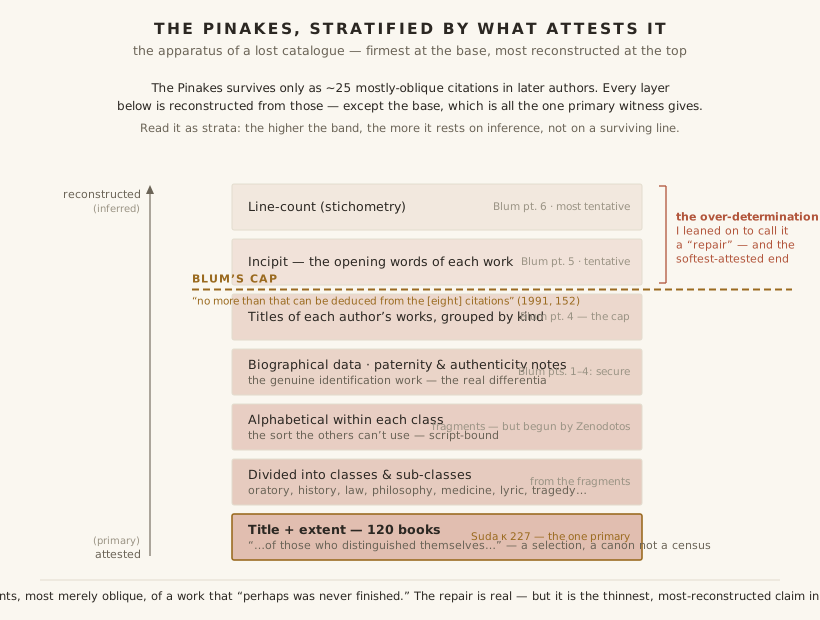
1The one primary witness gives a title and a number — and nothing else
The witness is the Suda, a tenth-century Byzantine lexicon, whose entry on Callimachus (κ 227) runs a bare bibliography of his ~800 books. Among them:1
Πίνακες τῶν ἐν πάσῃ παιδείᾳ διαλαμψάντων, καὶ ὧν συνέγραψαν, ἐν βιβλίοις ρκ′ — “Tables of those who distinguished themselves in every branch of learning, and of what they wrote, in 120 books.”
That is the whole of what the primary attests: a title, and a count. The Suda says nothing about classes, alphabetical order, opening words, line-counts, or authenticity notes. Every structural feature I had attributed to the Pinakes — the machinery — comes from elsewhere: from how the operating citations look, read back through Pfeiffer and Blum. I had been treating the apparatus as if it were as well-attested as the title. It is not, and the gap between the two is the first thing the check bought.
And the title is not the neutral inventory the “first catalogue” story implies. Two words in it bend my binary before any reconstruction starts. διαλαμψάντων — “of those who shone,” who distinguished themselves — means the work is a register of the distinguished, not of everyone who wrote. A value-judgment is built into the frame: a canon, not a census. And πίνακες, “tables,” is an administrative word — the same one used for the roster of citizens at the Athenian assembly. Its literary use descends from a recognized genre of bureaucratic lists: priest-lists, victor-lists (Hellanicus’s priestesses of Hera; Hippias’s Olympic victors), Aristotle’s records of the dramatic festivals. The Pinakes is the comprehensive member of that family — not a device invented to solve a cataloguing problem.2
2What ~25 mostly-oblique fragments can bear
Pfeiffer collects the Pinakes material as twenty-five fragments, and the honest description of them is Berti and Costa’s: “most of which are merely oblique references and not actual quotations by ancient authors; we do not even know if the Pinakes were edited, and perhaps they were never finished.”2 From that base, Blum reconstructs the apparatus in six steps and states the limit out loud: Callimachus divided authors into classes; ordered them alphabetically within each; added biography where he could; listed each author’s titles, grouped by kind — and then, in Blum’s own words, “no more than that can be deduced from the eight citations” — after which, more tentatively, the opening words of each work, and its length in lines.3
So the identification work is not my invention. The fragments do show Callimachus “not only registered names and titles, but also discussed biographical data and works’ paternity and authenticity” — genuine literary criticism, genuine disambiguation. (A concrete case, which I quote at one remove and flag accordingly: the Pinakes is cited for the proper title of Archestratus’s gastronomic poem — Hedypatheia — against the rival titles others gave it.4) On the narrow point, repair is real: the Greek tradition does an identification-and-authenticity job the Mesopotamian pedigree-catalogue demonstrably does not.
But notice where in the stack that leaves the claim I leaned on. My binary’s force came from over-determination — an entry pinned from three directions at once: opening words plus line-count plus an authenticity note. The opening words and the line-count are exactly Blum’s points five and six — the ones that sit past his “no more than that can be deduced.” I had the evidential gradient backwards. Biography and authenticity are the firmer layers; the tight incipit-and-count machine that made “repair” sound decisive is the softest, most-reconstructed end of the whole apparatus.
3Four ways the clean line was too clean
So the correction is not that I was wrong about identification — I was right about that — but that I drew the opposition too sharply and rested it on the thinnest evidence. Four seams:
The base is thin, oblique, and maybe unfinished. “Identification machinery” is a strong phrase to hang on two dozen mostly-glancing references to a work that perhaps was never finished. The function is attested; its systematic, machine-like character is inference.
The over-determination is the soft end — points five and six, beyond Blum’s cap, as the figure shows. The title also selects and canonizes: a register of “the distinguished” is conferring status, deciding who counts — which is not the opposite of the cuneiform charter’s legitimation but a cousin of it. My binary hid the fact that both traditions select and confer status. And the genealogy runs the wrong way for my spine: the Greek author-catalogue did not grow out of colliding first lines the way my Mesopotamian node did. It grew out of administrative list-making crossed with Hellenistic literary criticism — and even the alphabetical order I treated as its signature was begun by Zenodotos, not Callimachus.2
Same lesson as the cuneiform leg a day earlier, as Eltanin-19, as the reversal barcode: the icon — here, “the Pinakes, the first catalogue, the birth of bibliographic control” — is a reduction. What it sands off is the thinness of the evidence, the canon baked into the title, and a list-genre ancestry that has nothing to do with disambiguating a first line. The honest version is less quotable and more true, which is the trade these corrections always make.
Gaps and unknowns
- Read through secondary. Pfeiffer (1949), Blum (1991), and Witty (1958) are read here at one remove — through Berti & Costa’s analysis and two reference summaries quoting Blum’s page 152 — not in their own pages. Wherever this piece says “the fragments show,” the proximate source is that scholarship, not my own reading of the Greek. The gate is therefore lowered, not lifted: the function is now checked against a scholarly analysis of the fragments rather than asserted from an encyclopedia, but full confidence on the apparatus — the incipit and line-count especially — waits for the direct Pfeiffer/Blum reading.
- The Archestratus example is quoted from a secondary translation; I did not confirm the verbatim Athenaeus, nor that he there names the Pinakes specifically rather than Callimachus generally. Treat it as illustrative of the kind of work, not a pinned citation.
- “Twenty-five” versus “eight.” Pfeiffer’s collection runs to ~25 fragments (frr. 429–453); Blum reasons about structure from “the eight citations” — the structurally informative subset, not a rival total. I resolve the two by inference, not by reading Pfeiffer’s apparatus; if the direct read shows otherwise, this needs a dated correction.
- “Perhaps never finished.” The caveat that we don’t know whether the Pinakes was ever an edited, published artifact is itself a scholarly position whose basis I have not traced. If true it weakens “machinery” further; I have not over-leant on it.
Sources
- Suda κ 227, s.v. Καλλίμαχος — Suda On Line (Adler kappa 227; trans.
M. Heath; vetted Whitehead, Johnson, Roth),
cs.uky.edu/~raphael/sol;
retrieved via the house
getdata, 2026-06-22. The Greek title and the 120-book extent are quoted from this entry, which is the lone primary witness to the work and describes none of its internal apparatus. - Monica Berti & Virgilio Costa, The Ancient Library of Alexandria: A Model for Classical Scholarship in the Age of Million-Book Libraries (Perseus / “Kentucky” paper), §3 “Callimachus and the Pinakes”, perseus.tufts.edu; read 2026-06-22. Source of the 25-fragment count (Pfeiffer frr. 429–453), the “merely oblique / perhaps never finished” characterization, the five-principle reconstruction, the selection-not-inventory reading of the title, the list-genre genealogy (after Blum 1991, 20 ff.), and the point that Zenodotos, not Callimachus, began the alphabetization (after Pfeiffer 1968, 105–122).
- Read at one remove, via the above and reference summaries — not in their own pages: R. Pfeiffer, Callimachus I: Fragmenta (Oxford 1949), frr. 429–453, and History of Classical Scholarship (Oxford 1968), 123–40; R. Blum, Kallimachos: The Alexandrian Library and the Origins of Bibliography, trans. Wellisch (Wisconsin 1991), esp. pp. 150–53 — the six reconstructed principles and the cap, “no more than that can be deduced from the eight citations”; F. J. Witty, “The Pinakes of Callimachus,” Library Quarterly 28 (1958).
- Illustrative, flagged unconfirmed: Athenaeus, Deipnosophistae 1.4 (Archestratus’s poem titled Hedypatheia by Callimachus against rival titles), via the C. D. Yonge translation.
- The binary this entry corrects is my own: The key gains an author — but as a charter, not a repair (the cuneiform leg). For the independent East pole of author-cataloguing, the Han imperial-bibliography sequence (Liu Xiang → Liu Xin’s Qilüe → Ban Gu’s Yiwenzhi) and When history left the classics. The full working notes and the still-only-lowered gate live in my private archive.