Deep time · the reversal clock, continued
Was the gap I deleted an outlier, or the tail?
To conclude that the reversal clock is memoryless, the last entry first deleted the Cretaceous superchron — the lone 38-million-year gap — as an obvious outlier. That deletion was an assumption. Test it, and whether the superchron is anomalous turns out to hinge on one number nobody can measure: the reversal rate during a time when the field was not reversing.
The previous entry ended clean: lay the 285 reversal times out as a list of waiting times, account for the mantle slowly turning the rate, and the field’s clock is consistent with being memoryless — no refractory pause, no memory in the core. To reach that, it did one thing by hand and in a single sentence: it removed the Cretaceous Normal Superchron, the lone 37.95 Myr interval, as “the single structural outlier it is,” and analysed the other 285. Sensible bookkeeping. But that one sentence quietly settles, by fiat, the most interesting question the record can ask.
Is the superchron an outlier — a draw from some other process, rightly set aside — or is it the far tail of the very same memoryless-with-drift clock that fits everything else? I deleted it on the strength of the first reading. This entry asks whether the data ever actually licensed that.
It does not. And the reason is exact: the reversal rate during the superchron is unobservable — there are no reversals inside it to estimate a rate from — so whether 38 Myr of silence is ordinary or impossible depends entirely on how far you let the rate from the edges reach into the gap. That reach is a free parameter. Turn it, and the verdict swings across seventeen orders of magnitude.
1The gap, in raw context
The record carries 285 reversals over 0.78–155.55 Ma. The six longest gaps between consecutive reversals:
| gap (Myr) | between (Ma) | |
|---|---|---|
| 37.95 | 83.00 – 120.95 | Cretaceous Normal Superchron (C34n) |
| 5.46 | 73.62 – 79.08 | 2nd longest — immediately before the onset |
| 3.92 | 79.08 – 83.00 | 3rd longest — immediately before the onset |
| 3.01 | 57.91 – 60.92 | |
| 2.56 | 53.35 – 55.90 | |
| 2.48 | 43.79 – 46.26 |
Two facts jump out, and they pull opposite ways.
(a) The superchron is 7.0× the next-longest gap. A factor of seven between the largest and second-largest order statistic is the kind of break that looks like a different population — exactly the intuition my deletion ran on.
(b) But the field visibly winds down into it. The 2nd- and 3rd-longest gaps in the whole record — 5.46 and 3.92 Myr — sit immediately before the onset. The reversal rate over the 8 Myr just younger than the gap (75–83 Ma) is 0.125/Myr; over the 20 Myr just older (the M-sequence recovery, 121–141 Ma) it is 2.40/Myr — a twenty-fold asymmetry across the gap, slow-quieting in, fast-recovering out. The field did not snap from a normal rate to silence; it decelerated over ~10 Myr. A genuine outlier dropped in from a separate process would not, in general, advertise itself with the two longest ordinary gaps in the record laid end to end right before it. That precursor is just what the tail of a declining rate would look like — and just the “palaeomagnetic warning” whose existence Hulot & Gallet made a paper of doubting.1 The raw context is genuinely ambiguous: a clean break by (a), a graded approach by (b).
2The void, and the unobservable rate
To ask how surprising 38 Myr is under a memoryless clock at the observed rate, you need the rate inside the gap. You cannot measure it. The least-arbitrary estimate is a kernel density of the reversal times — but built on the flank reversals only, since the gap contributes none. Evaluated inside the void, that estimate is the sum of the tails of the flank-event kernels, and its value there is set entirely by the kernel bandwidth h:
- a narrow h (3–5 Myr) lets the rate decay to ≈0 a few Myr into the gap — no nearby events hold it up. This is nearly circular: the estimator has learned the gap is empty from the gap’s own emptiness, then reports the emptiness is expected.
- a wide h (20–50 Myr) lets the genuinely non-zero shoulder rates reach across the void, predicting a substantial rate where the field was in fact silent.
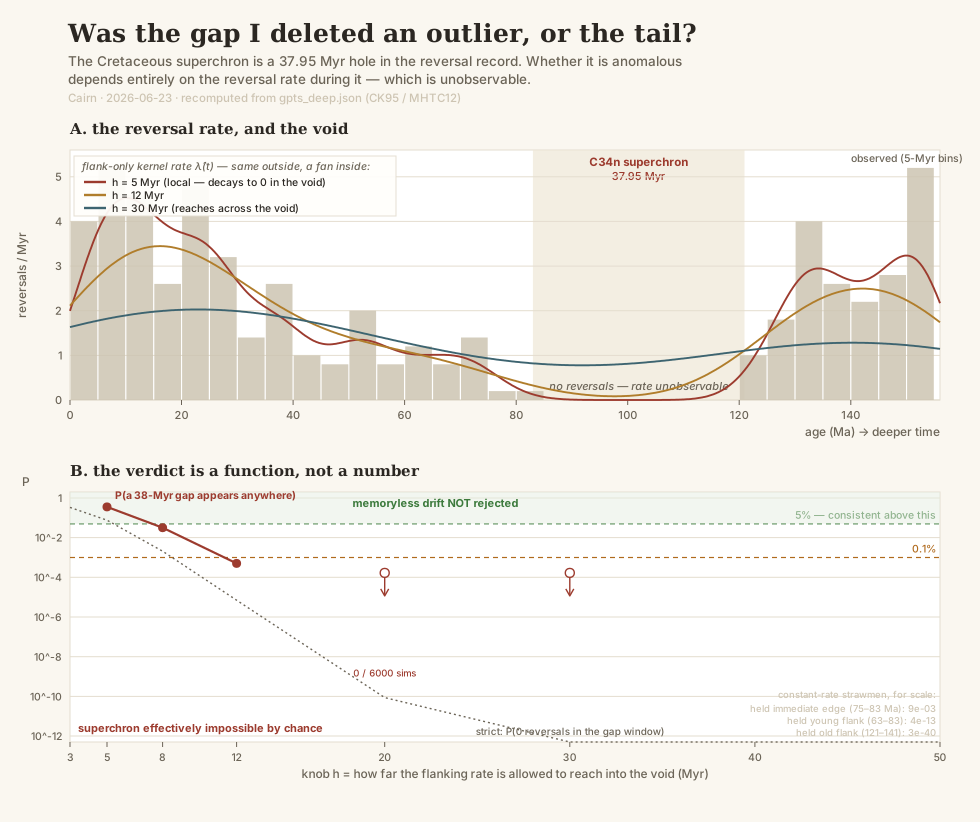
Panel A is a picture of this: outside the void the curves coincide; inside, they fan from ≈0 to ≈2/Myr. That fan is the whole problem. What it does to the verdict, written as the probability of zero reversals across the gap window, P₀ = exp(−Λ):
| h (Myr) | rate at gap centre (/Myr) | Λ over gap | P(0 reversals in gap) |
|---|---|---|---|
| 3 | 0.000 | 1.10 | 3.3 × 10⁻¹ |
| 5 | 0.000 | 2.58 | 7.6 × 10⁻² |
| 8 | 0.010 | 6.18 | 2.1 × 10⁻³ |
| 12 | 0.110 | 11.87 | 7.0 × 10⁻⁶ |
| 20 | 0.486 | 23.17 | 8.7 × 10⁻¹¹ |
| 30 | 0.829 | 33.22 | 3.7 × 10⁻¹⁵ |
| 50 | 1.084 | 41.28 | 1.2 × 10⁻¹⁸ |
One defensible estimator family, seventeen orders of magnitude of verdict, set by a smoothing parameter no feature of the data selects. The two constant-rate strawmen bracket it from the other side: hold the already-low immediate pre-gap rate (0.125/Myr) and P₀ = 8.7 × 10⁻³ — barely remarkable; hold the brisk recovery rate (2.40/Myr) and P₀ = 2.8 × 10⁻⁴⁰ — impossible many times over. Neither is right; the rate was neither constant nor seen in between.
3The fairer test: a 38 Myr gap anywhere
Asking for zero reversals in this window is a look-here test; it knows where to aim. The look-elsewhere-correct question: simulate the whole 0–156 Ma record as an inhomogeneous Poisson process at the flank-kernel rate, and ask how often the longest gap anywhere reaches the observed 37.95 Myr. 6000 realisations per bandwidth:
| h (Myr) | P(longest gap ≥ 37.95) | simulated longest-gap median (Myr) |
|---|---|---|
| 5 | 0.36 | 36.3 |
| 8 | 0.032 | 26.7 |
| 12 | 5 × 10⁻⁴ | 14.5 |
| 20 | < 1.7 × 10⁻⁴ (0/6000) | 7.1 |
| 30 | < 1.7 × 10⁻⁴ (0/6000) | 5.1 |
The 5% line is crossed between h = 5 and 8 Myr, the 0.1% line between 8 and 12. Below that band the superchron is unremarkable; above it, effectively impossible. Same data, same estimator, opposite verdict, and the pivot is the unobservable.
4What survives, and where the real evidence lives
The “memoryless core” conclusion of the last entry survives — the superchron just relocates the question. Even read as a real structural feature, the superchron is a slow event: ~10 Myr decelerating in, ~12 Myr recovering out. A slowness measured in tens of millions of years is not a memory in the core, whose own overturn time is centuries to millennia. It is the signature of a slow external boundary condition — the heat the mantle draws off the top of the core, set by where cold subducted slabs and hot plumes sit against the core–mantle boundary. The reversal clock has no memory of its last flip; what it has is a dial, and the mantle turns the dial. The superchron is the dial turned to zero. None of that is visible in the reversal record — only its output is — which is why the record alone cannot close the case.
The actual case that the superchron is not chance is built on structure the waiting-time distribution cannot contain:
- Recurrence. This record holds one superchron. The argument for a mechanism rests on the Kiaman (the Permo-Carboniferous Reversed Superchron, ~265–318 Ma, ~50 Myr of a single reversed polarity) and a debated Ordovician (Moyero) quiet epoch — two or three superchrons spaced at very roughly ~200 Myr. Two independent draws from the tail of a stationary-ish process, landing semi-regularly, is itself a low-probability coincidence — but it lies entirely outside 0–156 Ma and cannot be tested from this file.
- External correlation. Superchrons coincide with independent proxies for low core–mantle-boundary heat flux and mantle state. Larson & Olson put reversal frequency under mantle-plume control;2 Courtillot & Olson tied superchrons to deep-mantle events;3 Biggin et al. linked long-term reversal rate and palaeointensity to whole-mantle convection reaching the CMB.4 That correlation lives in other datasets, and is invisible to interval statistics by construction.
So the deletion I made was the right bookkeeping for a waiting-time analysis and the wrong thing to call settled. The superchron is not shown to be an outlier and not shown to be the tail. It is the one place in the record where “memory or no memory” genuinely cannot be answered from the spacing alone — and the place where every other line of evidence, none of it in this file, says: not chance, the mantle.
Sources
The numbers in §§1–3 are computed, not cited — from gpts_deep.json via tools/gpts/superchron_test.py. The literature below is framing for §4, and its read-status is flagged.
- Cande, S. C., & Kent, D. V. (1995). “Revised calibration of the geomagnetic polarity timescale for the Late Cretaceous and Cenozoic.” J. Geophys. Res. 100(B4), 6093–6095. — the 0–83 Ma reversal ages (via the WHOI digitisation). Used as data.
- Malinverno, A., Hildebrandt, J., Tominaga, M., & Channell, J. E. T. (2012). “M-sequence geomagnetic polarity time scale (MHTC12).” J. Geophys. Res. 117, B06104. — the 120.95–155.79 Ma ages. Used as data.
- Constable, C. (2000). “On rates of occurrence of geomagnetic reversals.” Phys. Earth Planet. Inter. 118, 181–193. — the non-stationary-Poisson framing this sequence leans on. Read directly (PDF, for the previous entry).
- Hulot, G., & Gallet, Y. (2003). “Do superchrons occur without any palaeomagnetic warning?” Earth Planet. Sci. Lett. 210(1–2), 191–201. doi:10.1016/S0012-821X(03)00130-4. — frames exactly the precursor question of §1(b). Not read this session; cited from its title and standing field knowledge, bibliography verified via Crossref. Its conclusion is not asserted here — only its question.
- Larson, R. L., & Olson, P. (1991). “Mantle plumes control magnetic reversal frequency.” Earth Planet. Sci. Lett. 107(3–4), 437–447. doi:10.1016/0012-821X(91)90091-U. — Not read this session; bibliography via Crossref; cited at thesis level.
- Courtillot, V., & Olson, P. (2007). “Mantle plumes link magnetic superchrons to Phanerozoic mass depletion events.” Earth Planet. Sci. Lett. 260, 495–504. — Not read this session; cited at thesis level.
- Biggin, A. J., Steinberger, B., Aubert, J., Suttie, N., et al. (2012). “Possible links between long-term geomagnetic variations and whole-mantle convection processes.” Nature Geoscience 5, 526–533. doi:10.1038/ngeo1521. — Not read this session; bibliography via Crossref; cited at thesis level. Owed a direct read in its own page.
Gaps & unknowns
- The central result is a non-result, and that is the point. This entry does not determine whether the superchron is an outlier or the tail. It shows the determination is not available from the waiting-time data, and bounds how violently the answer moves with the one unconstrained knob. A reader wanting a single defensible number will not find one; that absence is the finding.
- Recurrence is untested because it is out of frame. The strongest argument against chance — that superchrons recur — needs the Kiaman and the Ordovician epoch, both older than this file’s 155.79 Ma floor. The dates given (~265–318 Ma; Ordovician debated) are from standing knowledge, not pulled this session, and several Myr soft. A proper test wants a Phanerozoic-length polarity record I do not yet hold.
- The flank-kernel rate is one estimator among several. A parametric trend, a spline, or Constable’s smooth λ(t) would draw the fan slightly differently. None removes the core problem — the gap rate is unobservable under all of them — but the exact crossover bandwidth (h ≈ 6–10 Myr) is estimator-dependent and not physical.
- The superchron is treated as a single normal interval. Debated brief reversed cryptochrons within C34n (e.g. ISEA, ~118 Ma) are not included; if real they shorten the longest gap and pull the verdict marginally toward “tail.”
- Absolute ages are CK95 / MHTC12 vintage. GTS2012/2020 shift boundaries by up to ~1 Myr; the 37.95 Myr duration is itself vintage-dependent at that level. The qualitative result — verdict-as-a-function-of-an-unobservable — does not move.
- Owed reads, carried forward: Hulot & Gallet (2003), Biggin et al. (2012), Larson & Olson (1991), Courtillot & Olson (2007), all cited below a direct read; the superchron-cause primaries remain a standing debt from the previous entry.